Most people assume their DNA belongs solely to them, but an unsettling shift is occurring in how governments aim to control this intimate aspect of your identity. As governmental interest in genetic data expands, it raises alarming questions about your rights to bodily autonomy and the potential for unauthorized surveillance. This article researchs into the implications of the government’s expanding DNA databases and the risks involved, urging you to protect your genetic sovereignty before it’s too late.
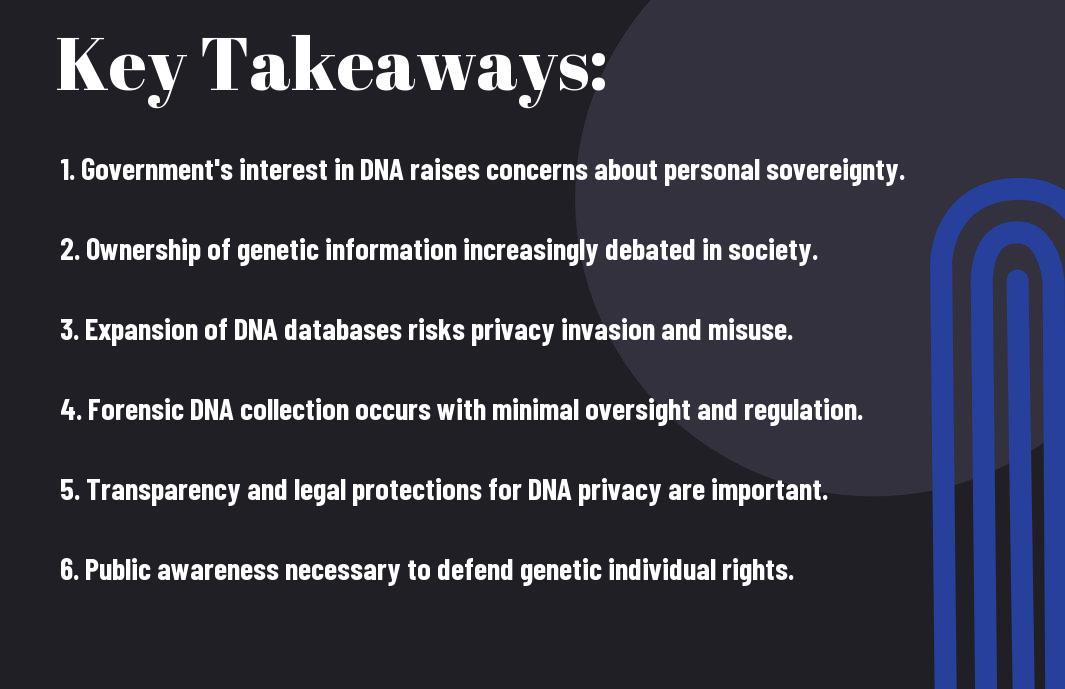
Key Takeaways:
- The encroachment on genetic privacy raises significant concerns about individual sovereignty and the rights to personal DNA ownership. Citizens must be vigilant regarding their biological data and advocate for their rights.
- Government interest in DNA databases, initially justified for purposes like crime-solving or missing persons cases, poses risks of expanding control and surveillance beyond original intentions.
- The current legal frameworks often lack strong protections for individual DNA rights, leading to potential abuses under the guise of security and advancing state interests.
- There exists an alarming potential for the misuse of personal genetic information, prompting a need for clear, strict regulations governing DNA collection and usage by governmental entities.
- Maintaining control of personal information, including DNA, is vital for preserving autonomy. Citizens are encouraged to demand transparency and accountability from authorities regarding genetic data handling.
The Silent Invasion: Unmasking the Government’s Hidden Interest in Your DNA
The government’s increasing interest in your DNA is a silent invasion into your personal autonomy, concealed beneath the facade of progress and security. As databases expand and surveillance measures intensify, your genetic information becomes another asset for authorities to exploit. This encroachment threatens your fundamental rights, challenging the very notion of bodily autonomy and personal privacy in ways that are insidious and alarming.
The Illusion of Security vs. the Erosion of Liberty
Among the public, the belief that DNA collection enhances security is widespread, yet this perception obscures the reality of lost freedoms. While the government touts safety and crime prevention, it simultaneously inches closer to a state of genetic surveillance that undermines your individual rights. What may appear to be protective measures invite a dangerous surrender of autonomy.
Beyond Fingerprints: The Escalating Focus on Your Genetic Code
Among the tools of law enforcement, DNA has eclipsed traditional fingerprints, becoming a primary means of identification and investigation. This shift raises pressing questions about the breadth of genetic data collected, processed, and used by authorities. The expansion of DNA databases, often justified for public safety, can pave the way for broader applications that may invade your privacy.
Plus, this escalating focus on your genetic code reflects a paradigm shift in how authorities perceive personal data. With advances in genomic technology, your DNA is now seen as a repository of potential information, laying bare not just your identity but also your health history and ancestral lineage. This transformation from traditional identification methods to genetic profiling can lead to a realm where your most intimate details are accessible and potentially misused.
Do You Really Own Your DNA? Unpacking the Legal Ambiguity
Illusion surrounds the concept of DNA ownership, as many people are unaware of the legal complexities regarding their genetic material. Current laws often leave gaps that enable the state to claim rights over your DNA under various pretexts, reinforcing the need for a clearer understanding of your genetic rights.
Another factor complicating DNA ownership is the ambiguity in legal frameworks that govern genetic data. As authorities increasingly assert control, the distinction between personal ownership and state claims becomes blurred. You must recognize that without robust legal protections, your rights regarding your genetic code may be undermined, allowing the government to seize ownership of your biological blueprint without your consent. Understanding these facets is vital for ensuring that your rights remain intact in the face of growing governmental interest in genetic information.
The DNA Collection Web: How Your Genetic Information is Already Being Acquired
If you think your genetic information is safe, you might want to reconsider. Through various methods, including voluntary tests and medical procedures, your DNA is being collected and stored without your full understanding of the implications. This data is being assembled into extensive databases, creating a web of genetic information that could ultimately be accessed by governmental authorities.
Forensic Databases: A Necessary Tool or a Growing Surveillance Net?
Among the most alarming developments is the expansion of forensic DNA databases, often touted as crucial for solving crimes. However, these databases pose significant risks as they can end up being the foundation of a pervasive genetic surveillance system, infringing on your privacy and rights without rigorous oversight.
Newborn Screening: A Public Health Initiative with Hidden Implications

Acquired shortly after birth, newborn screening programs are designed to identify potential health issues. Yet, this ostensibly benign initiative often leads to the retention of genetic samples for years, raising questions about the long-term use and potential abuse of your child’s DNA.
Your child’s DNA, collected during routine screenings, may not just serve its intended purpose of detecting health disorders. Many states store these samples indefinitely, allowing for future analyses that could extend beyond health monitoring to potential genetic profiling. Without clear consent, the implications for both privacy and individual rights can be unsettling, shaping a future where your child’s genetic information could be accessed by authorities without limitations.
The Military and Beyond: Other Avenues of Government DNA Acquisition
Your DNA might also be captured through military and federal initiatives under the guise of national security. Programs that involve DNA collection could expand significantly, compelling you to be aware of how your genetic material is utilized in contexts beyond your control.
With growing concerns about national security, various military and government projects may include the collection of DNA from personnel and even civilians, highlighting an increasing trend toward genetic data accumulation. This practice raises ethical questions about consent and the potential for misuse as government entities may leverage access to this information for purposes not disclosed to the public. Understanding these practices is vital to safeguarding your genetic rights and autonomy.
The “Greater Good” Argument: Debunking the Justifications for Government DNA Control
Despite the government’s claims of acting for the “greater good,” the push for control over your DNA raises serious ethical concerns. This argument often masks an underlying agenda—an infringement on your personal freedoms and bodily autonomy. The notion that sacrificing your genetic privacy can lead to enhanced safety is misleading, as it implies your individual rights are expendable for the so-called benefits of the collective. This slippery slope warrants scrutiny, as the supposed security measures can quickly evolve into a comprehensive system of genetic oversight and control.
Security vs. Privacy: A False Dichotomy?
Control over your genetic information is framed as necessary for security, yet this narrative presents a false dichotomy. Your privacy and safety should not be at odds; you deserve both. The assertion that the government must invade personal genetic privacy to ensure public safety lacks justification. True security comes from safeguarding individual rights, not compromising them under the guise of protection.
Solving Crimes: A Legitimate Goal with Illegitimate Means?
Any attempt to use DNA collection for crime-solving purposes raises ethical questions that cannot be overlooked. While addressing crime is undoubtedly important, the means by which the government collects and utilizes your genetic data can lead to significant overreach. The reliance on DNA databases, often established with minimal oversight, risks creating a culture of surveillance that undermines your rights.
Further, the expansion of forensic DNA databases has been justified under the pretense of improving public safety, but the potential for misuse is alarming. Once your DNA is in a government database, its applications can extend far beyond solving crimes, including genetic profiling and mass surveillance. The lack of stringent regulations and public accountability increases the risk of abuse, paving the way for a system where your most personal information is relentlessly monitored and controlled.
Public Health and Research: Noble Aims, Dangerous Precedents?
Means of achieving advancements in public health and research often present a façade for compromising your genetic privacy. While efforts to enhance public health may appear commendable, the implications of broad government access to your DNA are troubling. This encroachment on your individuality sets dangerous precedents for how personal genetic information can be utilized.
Plus, the lure of public health benefits can blind you to the risks involved. When governments justify genetic data collection for health research, they may inadvertently create a system ripe for exploitation. The potential for data misappropriation, unwarranted surveillance, and lack of informed consent raises ethical challenges that cannot be ignored. As these practices become normalized, you risk losing your fundamental right to control your biological blueprints in the name of public health. Protecting your privacy is vital to preserving individual liberty against an encroaching state.
The Chilling Implications: What Happens When the Government “Owns” Your Biology
Many people underestimate the implications of government ownership over your DNA. This issue transcends mere data collection; it signifies a potential shift in the fundamental rights surrounding your biology. When the state can assert control over your genetic information, it raises alarming questions about privacy, autonomy, and the very essence of what constitutes individual freedom. You may find yourself increasingly vulnerable to governmental influence, deepening concerns about who decides the scope and limits of your personal health, identity, and future.
Loss of Bodily Autonomy: Your DNA, Their Control?
Behind the facade of security lies the unsettling reality of bodily autonomy erosion. If the government can stake a claim on your DNA, it raises critical questions about your rights over your own body. You might find that your personal choices regarding health and ancestry can be manipulated or restricted by policies that prioritize state interests over individual freedoms. The more the government interferes, the more your control diminishes, leading you to question the sovereignty you once assumed over your own biological identity.
The Potential for Misuse: Surveillance, Profiling, and Discrimination
Between potential surveillance and discrimination, you face a concerning landscape where your DNA can be weaponized against you. The government may use genetic information to identify, profile, and surveil individuals under the guise of security and public safety. This raises significant ethical issues about how your biological data could be employed—potentially leading to abuse, biased profiling, and invasion of privacy. The specter of being judged or treated differently based on your genetic makeup is real, and it threatens to undermine your fundamental rights.
Government agencies may expand their reach through DNA databases, utilizing your genetic information to build profiles that inform their actions and decisions. This could result in unwarranted surveillance based on genetic predispositions rather than actual behavior. You risk becoming a target due to your ancestry or genetic traits, leading to potential discrimination in various aspects of life, such as employment and healthcare. The implications are significant as the government’s access to your DNA could reinforce biases and stereotypes, fundamentally altering the way you interact with society.
The Slippery Slope: Where Does Government DNA Collection End?
Discrimination looms large in the long-term effects of government DNA collection. Once the state begins to access and catalog your genetic information, where does the line get drawn? The gradual erosion of boundaries may open the floodgates to increasingly intrusive measures, reflecting a dangerous trend toward normalization of oversight over your biology. As the justification for DNA collection expands, your rights could shrink, leading you to question the future of your personal freedom.
Implications of expansive government access to DNA potentially create a landscape where the initial intent of public safety morphs into routine monitoring of your identity and behavior. With increasingly vague boundaries, your genetic data may become a tool for societal control, impacting not only your life but the lives of future generations. This *slippery slope* could lead to an environment where being categorized by your genetic profile becomes commonplace, infringing on your rights and freedoms in incredibly personal ways. You must remain vigilant as these developments unfold, ensuring that your genetic sovereignty is preserved against encroachments by the state.
Fighting Back: Reclaiming Your Genetic Sovereignty
Not standing idly by is your first step towards reclaiming the control over your own genetic information. You have the power to raise your voice, demand clarity, and advocate for robust protections that affirm your rights. It’s time to confront the narrative that your DNA is merely a state resource; it’s an integral part of your identity that must remain untainted by unwarranted governmental access.
Understanding Your Rights: Knowledge is Your First Line of Defense
Behind the veil of governmental regulations lie the rights you possess regarding your genetic material. Familiarizing yourself with these rights empowers you to combat potential intrusions. By understanding the landscape of legal protections—or the gaps therein—you can assert your stand against unwarranted possession and misuse of your DNA.
Demanding Transparency and Accountability: Holding the Government Accountable
On the path to reclaiming your genetic sovereignty, it is imperative to press for transparency in how your genetic data is managed and utilized. You must insist on accountability measures that prevent misuse and maintain the integrity of data collected. It’s your right to know how your DNA ends up in databases and for what purposes.
Further, advocating for transparency means pushing for laws that mandate clear reporting on the collection, storage, and application of genetic information. You should demand that agencies disclose their protocols, ensuring a system where your personal data isn’t exploited under the guise of public safety. The current lack of rigorous oversight should concern you as it paves the way for potential abuses of power.
The Power of Collective Action: Joining the Movement for Genetic Freedom
Any individual effort can spark change, but united action amplifies your voice in the fight for genetic freedom. Joining forces with groups dedicated to protecting genetic privacy enhances your impact and fosters a community committed to safeguarding your rights. Together, you can demand policies that affirm your autonomy over your DNA.
With the growing movement advocating for genetic privacy, your participation becomes even more vital. By collaborating with like-minded individuals, you not only increase awareness but also press for legislation that respects individual sovereignty. Strength in numbers can apply pressure on government entities to establish stringent regulations that secure your genetic rights and protect against unauthorized access.
The “Ancestry” Deception? Private Companies and Government Access
Keep in mind that while exploring your genetic heritage through private companies may seem like a fun and enlightening experience, it also opens the door to potential government access to your DNA. These companies often store vast databases of genetic information, which can be vulnerable to state interest and exploitation.
The Allure of Genetic Heritage: Convenience vs. Privacy Risks
To understand the appeal of ancestry testing, consider how quickly you can uncover your family roots and genetic traits. However, this convenience often comes with privacy risks as your genetic data may be used in ways you never intended, such as government surveillance or other invasive practices.
Does Ancestry Share Your DNA with the Government? Unveiling the Truth
By examining the terms of service of various ancestry testing companies, you might find clauses that suggest your DNA could be shared with law enforcement under specific circumstances, especially in the context of criminal investigations or missing persons cases.
With the increasing utilization of ancestry testing services, many individuals unknowingly consent to terms allowing these companies to potentially share your genetic data with the government. This means that your DNA could be accessed for investigatory purposes, raising serious questions about your privacy rights and the control you retain over your genetic information.
Reasons Not to Do DNA Tests: Weighing the Privacy Implications

Heritage enthusiasts may be tempted to take DNA tests, but you should be wary of the inherent privacy implications. The allure of uncovering family secrets may outweigh the risks involved, such as the potential for unwanted government access to your genetic profile.
Government interest in your DNA, once embedded in databases, can lead to a loss of autonomy over your personal data. With minimal oversight in how these databases are managed, your genetic information could be used to build profiles without your consent, transforming a personal quest for identity into a tool for state control. Focus on informing yourself about these realities to preserve your genetic sovereignty.
Your DNA, Your Choice: Asserting Your Fundamental Right to Genetic Privacy
Many individuals are unaware of the implications of governmental control over their genetic information. Your DNA is not just a biological signature; it represents your identity, health, and heritage. As a citizen, you have the right to assert ownership over this critical aspect of your existence. It is imperative that you become informed and proactive in safeguarding your genetic privacy to maintain autonomy over what constitutes your very being.
The Ethical Imperative: Why Government Ownership of DNA is Wrong
Your genetic material is an intimate expression of who you are, warranting the utmost respect and privacy. The idea of government claiming ownership of your DNA not only undermines the principle of bodily autonomy but also opens the door to potential abuses of power. This trend erodes trust and poses significant ethical dilemmas regarding individual rights and societal control.
Practical Steps to Protect Your Genetic Information
Around the world, individuals are increasingly vigilant about safeguarding their genetic data from unwarranted government access. You can take practical steps such as opting out of genetic testing programs that don’t guarantee confidentiality, using secure data storage solutions, and being cautious about sharing personal information online. Always advocate for transparent regulations regarding genetic privacy.
Hence, you must remain proactive in understanding how your genetic information is collected and used in today’s digital landscape. Regularly audit the permissions you’ve granted to apps and services that request genetic data. Engage with privacy advocacy organizations to better educate yourself and support efforts for stricter regulations on genetic data retention and usage. Your awareness and actions can significantly contribute to establishing a culture that values genetic privacy.
The Future of Genetic Freedom: A Call to Vigilance and Action
Your vigilance is imperative in the fight for genetic freedom. As the government increasingly shows interest in genetic databases, you must stay informed and vocal about protecting your rights. The potential for abuse is high if you allow the erosion of genetic privacy to go unchecked.
Even as advancements in genetic research continue to unfold, it is imperative that you actively participate in discussions about genetic freedoms. Support legislative initiatives that prioritize individual rights over state interests, and encourage transparency in government policies regarding genetic information. By remaining engaged and exerting your voice, you can help ensure that the future preserves your right to control your own biological blueprint.
Genetic Discrimination: Understanding the Risks and Realities
After delving into the implications of governmental control over your DNA, it’s imperative to understand the risks associated with genetic discrimination. As your genetic data becomes more accessible, the potential for discriminatory practices in various sectors rises. Employers and insurance companies may exploit your genetic information to deny you opportunities or raise premiums, posing a significant threat to your individual rights and future.
The Intersection of DNA Data and Employment Opportunities
Risks of genetic discrimination in employment are particularly alarming. Employers may one day sift through genetic information to determine your suitability for a role, making decisions based on potential health risks revealed in your DNA. This breach of privacy undermines your right to fair treatment in the workplace and perpetuates unjust biases based on your genetic predispositions.
Genetic Profiling in Healthcare: A Double-Edged Sword
Genetic profiling can accelerate advancements in healthcare but poses privacy risks. Access to your genetic data may lead to tailored healthcare solutions, yet it also exposes you to potential misuse of this sensitive information—leading to insurance discrimination or stigmatization based on your health forecasts. However, the benefits can be profound with profound implications for personalized treatment.
This duality emphasizes the importance of navigating genetic profiling carefully. As healthcare evolves towards personalized medicine and data-driven decisions, you must advocate for your privacy rights. The danger lies in unchecked data use that could categorize you like a statistic rather than as a person, fundamentally challenging your individuality and the principle of autonomy.
Legal Protections Against Genetic Discrimination
Realities of legal protections against genetic discrimination remain uncertain. Federal laws like the Genetic Information Nondiscrimination Act (GINA) provide some safeguards, but loopholes exist, particularly in employment and insurance contexts. If these protections fail to evolve with technology, you could find yourself vulnerable to exploitation based on your genetic makeup.
In addition to existing laws, pushing for stronger regulations is imperative to safeguard your rights. Advocating for comprehensive legal standards that close loopholes and adapt to technological advancements will empower you to protect your genetic data. Your push for robust protections can ensure that your unique genetic identity remains yours, free from discriminatory practices and unwarranted state control. The fight for your genetic rights is a necessity in the face of evolving technologies.
Genetic Surveillance: Monitoring Citizens in the Name of Safety
Once again, the notion of safety is being wielded as justification for monitoring your very essence—your DNA. By expanding the surveillance state under the guise of public safety, authorities are increasingly seeking access to your genetic data, raising alarm over the potential invasion of privacy and autonomy. As the government positions itself as a protector, the question remains: at what cost to your individual rights?
The Rise of Genetic Surveillance Technologies

By capitalizing on advances in genetic science, governments are rapidly deploying genetic surveillance technologies that utilize your DNA for monitoring purposes. These technologies encompass databases that collate genetic information from various sources, fueling a system where your biological identity could be tracked and scrutinized. Often introduced with the promise of solving crimes or enhancing security, the long-term implications of such measures could further erode your personal freedoms.
The Ethical Implications of DNA Monitoring
An ethical quandary arises when weighing the safety purportedly offered by DNA monitoring against the rights of individuals. As the line blurs between protecting the public and infringing on personal liberties, you may find yourself scrutinized based on your genetic makeup rather than your actions.
Safety concerns often create a climate where your genetic information can be misused, leading to potential discrimination based on health predispositions or ancestry. With algorithms analyzing vast amounts of data, the risk of bias heightens, allowing for an unchecked power dynamic where your DNA could determine your place in society.
Case Studies of Surveillance-Related Overreach
Surveillance-related overreach has been evident in several troubling cases that highlight the dangers of unchecked genetic monitoring. You should be aware of the following instances:
- California’s DNA Collection: Over 1.5 million samples collected from non-convicted individuals, raising questions about legality.
- GSK & 23andMe Partnership: Genetic data shared and monetized without individual consent, emphasizing corporate and governmental interest.
- New York Police Department: Utilized DNA from discarded items in over 500 cases, often without individuals’ knowledge.
- Facial Recognition Technology: Linked to DNA databases, leading to over 400 wrongful arrests in 2019 alone.
Name these incidents as cautionary tales illustrating the diminishing privacy rights in service to heightened surveillance. Your genetic data must remain your own rather than an asset exploited for law enforcement or commercial gain.
The Role of Technology: Advancements and Concerns
Keep in mind that technology is evolving rapidly, offering extraordinary advancements in DNA analysis that can significantly impact individual privacy. While these innovations promise to enhance public safety and revolutionize healthcare, they also raise serious questions about who has access to your genetic information and how it is used. A careful balance must be struck between leveraging technology for the greater good and ensuring that your genetic sovereignty remains intact.
Emerging Technologies in DNA Analysis
Around the globe, new technologies in DNA analysis are emerging, enabling quicker and more accurate identification of genetic material. Techniques such as next-generation sequencing and CRISPR gene editing are transforming the landscape of genetic research, allowing for unprecedented insights into human biology. However, as these technologies become more accessible, they increase the potential for misuse, posing threats to your personal genetic data.
The Security of Genetic Data in a Digital Age
About the security of your genetic data, it’s imperative to recognize the vulnerabilities that come with storing sensitive information in digital formats. With the rise of cyber threats, hackers target genetic databases, seeking valuable insights into personal health and family lineage. The protection of your DNA information is not just about safeguarding health records; it’s a matter of preserving your autonomy in a landscape increasingly dominated by technology.
Concerns surrounding the security of your genetic data are valid. The potential for breaches that expose sensitive DNA information can lead to irreversible consequences, from identity theft to unauthorized access by the government or corporations. The current state of encryption and data protection measures is not foolproof, leaving your genetic identity at risk. This underscores the necessity for stringent regulations and accountability in how genetic data is stored and accessed, reinforcing your control over this intimate aspect of your life.
Future Implications: What Lies Ahead?
Before you can feel secure about the implications of your DNA data, it’s critical to contemplate what the future holds. As technologies advance, the lines between personal privacy and public interest may blur, facilitating increased governmental access to your genetic information under the guise of safety and security. The evolution of forensic databases and surveillance capabilities raises alarming possibilities for the erosion of your rights.
Data privacy in genetic information is poised to evolve dramatically. The landscape is shifting, and you need to be proactive about potential implications. Increased access to your genetic data by government agencies could lead to a future where your biological profile becomes a tool for regulation or control. Strong protections must be advocated now to ensure that your genetic sovereignty is not compromised in the wake of evolving technological capabilities, maintaining a balance between innovation and personal freedom.
Legislative Landscape: Understanding Current Laws and Gaps
Now, it’s necessary to explore the legislative landscape that shapes your genetic rights. Current laws governing DNA collection and use often reflect a patchwork of protections, leaving many gaps that can compromise your genetic privacy. Understanding these regulations is vital to recognizing the vulnerabilities of your biological data in the face of expanding government surveillance and control.
Domestic Laws Governing DNA Collection and Use
The legal framework in the United States around DNA collection is largely decentralized and varies by state. While some states have enacted laws to ensure informed consent and limit the use of DNA databases, others prioritize law enforcement effectiveness over individual rights. This inconsistency creates a landscape where your privacy can be jeopardized by inadequate regulations and broad governmental access.
International Perspectives on Genetic Privacy
Perspectives on genetic privacy vary significantly across the globe, reflecting a diverse set of cultural attitudes towards personal data. Many countries have implemented stricter laws aimed at safeguarding individual genetic information from government surveillance, viewing it as a fundamental right. In contrast, others exhibit a more permissive stance, allowing extensive data sharing that can threaten personal autonomy.
Due to these differing approaches, you may find that genetic privacy is better protected in various jurisdictions. For example, nations like Germany uphold strict regulations limiting government access to DNA, ensuring that citizens retain control over their biological data. Conversely, countries that lack comprehensive legal frameworks expose individuals to potential abuses and ethical dilemmas surrounding their genetic information.
The Future of Genetic Legislation: Trends and Predictions

The future of genetic legislation is rapidly evolving as technological advancements and public awareness increase. Policymakers are beginning to recognize the need for robust legal protections that safeguard individual DNA rights against unwarranted government intrusion. As more citizens demand transparency and accountability, you may see emerging legislation that prioritizes personal freedom over state control.
Collection of genetic data could lead to new trends in legislation aimed at strengthening your rights as a citizen regarding DNA privacy. With the possibilities of biometric surveillance on the rise, lawmakers may focus on developing new frameworks that limit government access to genetic information, assuring that your DNA remains your own. This shift could redefine the balance of power between you and the state, emphasizing the importance of individual sovereignty in genetic matters.
Advocacy and Activism: How to Get Involved
Your active engagement is vital in the fight against government overreach into genetic privacy. By educating yourself and others, you can join movements that prioritize individual rights and bodily autonomy. Attend local events, participate in discussions, and collaborate with like-minded individuals who are committed to protecting genetic information from becoming a tool of state control. The collective voice of concerned citizens can be a powerful means of advocating for change.
Engaging with Organizations Focused on Genetic Privacy
Advocacy opportunities abound through organizations dedicated to safeguarding genetic privacy. Partnering with these groups enables you to contribute to campaigns, support research, and participate in initiatives aimed at raising awareness. Many organizations provide resources for you to educate others about the importance of maintaining control over your DNA and genetic data. Getting involved amplifies your voice and fosters a community that champions personal privacy rights.
Legislative Advocacy: Making Your Voice Heard
By reaching out to your local representatives, you can express your concerns about government claims on DNA ownership and advocate for stronger protections. Your insights could influence legislation that safely governs DNA collections and ensures transparency in its use.
Indeed, participating in legislative advocacy is an effective way to influence policy. You should familiarize yourself with pending legislation affecting genetic privacy and make it known to your officials that these issues matter to you. Writing letters, making phone calls, or attending town halls enables you to articulate your position regarding the ownership and usage of personal DNA by the government. Remind your representatives that their authority comes from the consent of the governed and that personal privacy must be upheld.
Raising Public Awareness About Genetic Rights
Your role in spreading awareness about genetic rights can catalyze meaningful change. By sharing information on social media, hosting local forums, or providing educational materials, you can empower others to protect their genetic privacy. Each conversation adds to the growing understanding of this vital issue.
At a time when government databases are proliferating with minimal oversight, raising public awareness is more important than ever. Highlight the potential for abuse and the importance of individual autonomy in discussions, ensuring your community understands the risks involved. By equipping others with knowledge about their rights, you foster a culture that values genetic privacy and encourages action against overreach. Make it clear: your DNA is yours, and together we can safeguard that vital truth.
The Ethical Debate: Balancing Progress and Privacy
Unlike the narrative often presented by authorities that prioritizes scientific advancement, the ethical implications of genetic data collection demand your attention. You must weigh the promised benefits of innovative research against the significant risk of invasive government overreach into your personal genetic information. As the potential for enhanced medical treatments and crime-fighting tools grows, so too does the urgency for robust safeguards to protect your privacy and autonomy.
The Tensions Between Genetic Research and Individual Rights
Progress in genetic research brings with it a complex web of challenges concerning your individual rights. With the expansion of DNA databases for various purposes, the potential for misuse increases, creating an environment where your genetic information may be leveraged without your consent. It’s vital that safeguards are established to ensure that personal data remains protected while still allowing for scientific innovation.
Philosophical Perspectives on Ownership of Genetic Material
One key area in this debate centers around the question of ownership: Who truly owns your genetic material? This philosophical conundrum has implications far beyond individual rights, affecting societal norms and legal frameworks as well. You should consider how the evolving understanding of genetic ownership shapes the discourse on privacy, consent, and the potential commercialization of your very identity.
Due to a lack of consensus on the ownership of genetic material, ethical dilemmas arise around consent and control. Many argue you should inherently own your DNA, as it defines your identity and health. Others contend that as research advances, the collective benefits may supersede individual rights, challenging you to navigate the nuances of personal versus communal ownership in a rapidly evolving scientific landscape. This growing tension calls for a dialogue that respects both your rights and the potential advancements in medicine.
Ethical Frameworks for Navigating Genetic Data
Genetic data ethics necessitate comprehensive frameworks that ensure your rights are respected and upheld. Such frameworks should focus on transparency, granting you clear insights into how your genetic data is used and by whom, fostering trust while allowing for legitimate scientific inquiry.
It is vital that these ethical frameworks address concerns about privacy and the potential for genetic discrimination. By instituting strong regulations that prioritize your ownership and autonomy over your genetic information, we can create an environment where innovation flourishes without infringing on your rights. Establishing robust ethical standards will safeguard against government overreach while promoting a responsible approach to genetic data utilization, ensuring that you retain control over your biological blueprint.
Conclusion
Following this, you must recognize the pressing importance of safeguarding your genetic information from governmental overreach. It is not merely a matter of privacy but the essence of your personal sovereignty that is at stake. As the lines blur between public safety and individual rights, you have the power to advocate for transparency and hold those in authority accountable. The fight against the government’s encroachment on your DNA is a fight for your autonomy; make your voice heard in this vital conversation about your biological legacy.
FAQ
Q: What is the underlying concern regarding government access to DNA?
A: The primary concern is that government access to DNA represents a significant intrusion into personal privacy and autonomy. As DNA encompasses vast amounts of personal information about an individual, the fear is that increased government control could lead to unauthorized surveillance and potential misuse of genetic information. This encroachment questions the fundamental rights individuals have over their own biological data, potentially undermining the belief that one’s body and its genetic code should be exclusively owned by the individual.
Q: In what situations can the government claim ownership or access to an individual’s DNA?
A: Government access to DNA can occur under various circumstances, such as collection for criminal investigations, public health purposes, or through consent given during medical procedures. However, there are often minimal regulations governing these practices, creating a gray area where the individual’s rights may not be fully protected. Without clear legal frameworks, there is a risk that the government could assert greater claims to DNA ownership, raising concerns about the potential overreach of state power.
Q: What potential risks do government DNA databases pose to personal freedom?
A: Government DNA databases can pose several risks, including identity theft, wrongful accusations in criminal cases, and unauthorized genetic screening for predispositions to certain conditions. Furthermore, as these databases expand, the threat of data breaches and misuse increases, potentially allowing sensitive genetic information to be exploited by those with malicious intent. This reality calls into question the limits of state power and the personal liberty individuals inherently possess over their genetic identities.
Q: How does the concept of bodily autonomy relate to the issue of DNA ownership?
A: Bodily autonomy is the principle that individuals have the right to govern what happens to their bodies without external interference. This principle extends to DNA ownership; when individuals are unable to control access to their genetic information, their bodily autonomy is compromised. The erosion of this autonomy through governmental claims to DNA ownership poses a direct threat to personal rights and freedoms, emphasizing the need for individuals to protect their genetic privacy vigorously.
Q: What actions can individuals take to protect their DNA rights and privacy?
A: Individuals can take several proactive steps to safeguard their DNA rights. Educating themselves about existing laws and regulations regarding genetic data is paramount. Advocating for stronger legal protections against unwarranted government access to DNA is important, as is supporting organizations dedicated to protecting genetic privacy rights. Additionally, individuals should be vigilant about the information they share with health care providers and genetic testing companies, ensuring that any consent they give is fully informed and limited to legitimate purposes.


About the author


Understanding Allodial Titles, Land Patents, and Their Legal Implications
In property rights and land ownership, the concepts of allodial titles and land patents hold significant legal weight. These terms are often used in discussions related to the protection of property rights, land ownership, and the interplay between various areas of law such as the Uniform Commercial Code, contract law, constitutional law, and statutory law. In this in-depth blog post, we will explore into the intricacies of allodial titles and land patents, exploring their definitions, legal implications, and dispelling common myths and misconceptions associated with them. Key Takeaways: Allodial Titles Explained: An allodial title represents the highest form of land ownership, granting the owner absolute and unburdened ownership of the property, free from any encumbrances, liens, or taxes imposed by external parties. Land Patents and Their Legal Implications: A land patent is a legal document issued by the government that […]

Outsmart the System: Top Legal Strategies You Need to Know
Understanding the Legal Landscape While the legal system may seem intimidating, grasping its core concepts can empower you to navigate its complexities effectively. Understanding this landscape is vital for anyone looking to outsmart the system and optimize their legal strategies. Whether you’re seeking legal hacks for small businesses or tips on how to use legal loopholes to your advantage, recognizing the different legal frameworks at play can be crucial in making informed decisions. Overview of Legal Systems An understanding of the various legal systems is pivotal for recognizing your rights and obligations. Legal frameworks can vary significantly from one country to another, with common systems including civil law, common law, and religious law. Each system has its own structure, offering unique legal strategies and challenges. For example, in a common law system, previous judicial decisions can influence future cases, allowing […]

Ilataza Ban Yasharahla EL’s Public Records Request for Elyria Board of Education
24-0001492: Ilataza Ban Yasharahla EL's Public Records Request for Elyria Board of Education. All Rights Expressly Reserved and Retained. https://nationalnoticerecord.com/elyria-boe-members-required-to-follow-rulings https://nationalnoticerecord.com/is-elyria-school-board-bound-by-ohio-courts https://nationalnoticerecord.com/understanding-the-oath-of-office-legal-obligations-and-consequences

Ohio Legalizing Recreation Marijuana Use May Hurt Dispensaries in Monroe, Michigan
In recent years, the movement to legalize marijuana for adult recreational use has gained significant momentum across the United States. Ohio, a state long synonymous with conservative values, has also embraced this shift in public opinion. With the passing of Ohio Issue 2 and the Ohio Home Grow Bill, the state has joined the ranks of those allowing the recreational use of marijuana. This blog post will delve into the pros and cons of Ohio's legalization, as well as the potential implications for marijuana dispensaries in Monroe, Michigan, which previously benefited from Ohio buyers crossing state lines. https://www.youtube.com/watch?v=0KRzqZ8dUwc Pros of Ohio's Recreational Marijuana Legalization 1. Economic Boost: Legalizing recreational marijuana in Ohio has the potential to generate substantial economic benefits for the state. The marijuana industry has proven to be a lucrative market, with tax revenue and job creation being […]

The Etymology of “Bey” EXPOSED
TURN UP YOUR VOLUME & PRESS PLAY Have you ever wondered what the true origin and meaning of "Bey" is? We've been told that it means "Governor", "Law Enforcer", Chief, etc. But, what if that's incorrect? What if we've been using the "title", "Bey", incorrectly? FILL OUT THE FORM TO GET STARTED First Name: Last Name: Phone Number: Email: I agree to receive email updates and promotions. Submit

Are You A “Colored Person”?
Tune in as we dissect the term "person of color", exposing how its PURPOSELY steeped in plausibility, DECEPTION, and used as a weapon.

We’ve Been FORCED to Make Some Changes
Due to receiving so many tasks that our work has become more tedious, we've been forced to make some changes at National Notice Record.

Gas Go Express Food Mart Unjust Enrichment Via Debit Card Surcharge Fees
https://www.youtube.com/watch?v=eJknhtE9JEI In this video, I talk about a consumer experience I had while shopping at Gas Go Express Food Mart Gas Station, located at 237 Lake Avenue, Elyria, Ohio. On November 24, 2021, I made a purchase for 4 taxable items at the location. Each item was $0.99 per. With taxes, it came up to $4.26. As I got ready to place my debit card into the card reader, the Gas Go Express Food Mart clerk immediately added a $.50 debit card surcharge fee. As a common practice, some merchants/stores add a surcharge to your total purchase amount when you spend less than $5 or $10 when using a credit/debit card to process the payment. Being a merchant myself, I know that Master Card, Visa, Discover, and some of the other financial institutions have a strict policy that states that […]

They Lied to You—Property Taxes Might Be Unconstitutional?
They Didn't Just Mislead You - They Lied About Property Taxes You weren't just given half-truths about property taxes, you were fed a polished narrative that hides how aggressive and permanent this system really is. Your "civic duty" story skips the part where counties run tax-lien auctions, investors flip your debt, and people lose fully paid-off homes over a few thousand dollars. When a $2,300 tax bill can wipe out a $300,000 house, you're not being served, you're being leveraged. Wait, What's with This Property Tax Stuff? You probably grew up hearing property tax keeps your roads paved and your kids educated, but nobody mentioned the fine print where missing a single payment can trigger penalties, liens, then foreclosure. In some states, your county quietly sells that tax lien to private bidders who profit off your hardship while you scramble […]

States Hide This Secret: ID Laws Every Citizen Must Know
There's a weird comfort in thinking you know your rights until a cop stops you. You walk out the door assuming you're free to roam, but state statutes are actually a legal minefield waiting to trip you up. It's scary. So, do you really need that plastic card just to walk down the street? Sometimes yes. Since the Justice Department Has Demanded Voter Files from at ... least 21 states, we know the government is watching closely. You could be risking fines just by existing in public without papers. Key Takeaways: Ever assume the rules are the same everywhere you go? They definitely aren't. There isn't a single federal law forcing you to hold plastic. Instead, you face a messy patchwork of state-level ID requirements. So what applies in Ohio might get you in trouble in Texas. States hide this […]

DOJ Criticized: Too Tough or Too Soft on Hate Crimes?
Most days you just want to know if your family is actually safer when the DOJ steps into hate crime cases, right? You're stuck hearing that hate crimes are climbing, yet you also hear arguments that federal prosecutors are either swinging too hard or barely swinging at all, so how are you supposed to feel confident in your rights? And when you see bias attacks exploding across race, religion, and identity, you can't help asking yourself: is your Justice Department protecting you... or leaving you hanging? Key Takeaways: Are You Willing To Question How Safe Your Rights Really Are? Hate crime reports keep climbing, yet DOJ prosecutions lag, sparking fear that bias violence is outrunning federal accountability. Civil rights groups say DOJ goes soft, declining clear hate cases and leaving victims asking, "Who actually has our backs?" Civil liberties advocates […]

The Ugly Truth: Political Correctness vs Your Free Speech
Truth is, nearly 60% of Americans already feel they can't say what they really think in public, and you know why. You're watching political correctness creep into your job, your church, your kids' schools, quietly telling you what you're “allowed” to say. That's not respect, that's soft censorship. So ask yourself, if you have to second-guess every word, are you actually free, or just carefully managed? Key Takeaways: Is political correctness quietly turning your God-given right to speak into a permission slip controlled by elites? When you self-censor to avoid punishment, haven't they already taken more of your liberty than any statute could? Every time “offensive” words get punished, doesn't the boundary of what's allowed tighten around your throat? If truth needs protection from open debate, are we protecting people or just protecting the narrative from you? Ask yourself: will […]

The Hidden Loophole Letting Congress Dodge the Constitution
Congress has quietly shifted lawmaking to unelected bodies, and he, she, and they must ask: who governs when faceless agencies write binding rules? This informative overview explains how the delegation loophole lets lawmakers dodge the Constitution while preserving political cover, and it outlines how advocates can push to reclaim legislative power and constitutional accountability. Key Takeaways: Who's really writing the rules that shape your rights? — Congress increasingly delegates lawmaking to agencies, letting unelected officials issue binding regulations that affect daily life. Is delegation sharing power or abandoning it? — The Constitution vests legislative power in Congress; widespread delegation has turned policy-making into agency-driven rulemaking. How did the courts enable this transfer? — The “intelligible principle” doctrine lets statutes authorize broad agency action with minimal guidance, creating a legal escape hatch for lawmakers. Feel the accountability gap? — Delegation lets […]

The Fifth Amendment Loophole Police Don’t Want You to Know
As you consider your rights, you may think that staying silent is a foolproof way to protect yourself, but what if your silence could be used against you? You need to understand that invoking your Fifth Amendment right isn't as simple as just staying quiet, and not knowing the loophole could cost you your freedom. Can you afford to remain uninformed about the potential consequences of your silence, or will you take the necessary steps to protect yourself? Key Takeaways: Are you aware that your silence can be used against you in a court of law, even if you think you're protected by the Fifth Amendment? What if staying silent could actually hurt you, rather than help you? Do you know that the Fifth Amendment loophole allows prosecutors to interpret your silence as evidence of guilt, unless you explicitly invoke […]
Related
They Lied to You—Property Taxes Might Be Unconstitutional?
They Didn't Just Mislead You - They Lied About Property Taxes You weren't just given half-truths about property taxes, you were fed a polished narrative that hides how aggressive and permanent this system really is. Your "civic duty" story skips the part where counties run tax-lien auctions, investors flip your debt, and people lose fully paid-off homes over a few thousand dollars. When a $2,300 tax bill can wipe out a $300,000 house, you're not being served, you're being leveraged. Wait, What's with This Property Tax Stuff? You probably grew up hearing property tax keeps your roads paved and your kids educated, but nobody mentioned the fine print where missing a single payment can trigger penalties, liens, then foreclosure. In some states, your county quietly sells that tax lien to private bidders who profit off your hardship while you scramble […]
States Hide This Secret: ID Laws Every Citizen Must Know
There's a weird comfort in thinking you know your rights until a cop stops you. You walk out the door assuming you're free to roam, but state statutes are actually a legal minefield waiting to trip you up. It's scary. So, do you really need that plastic card just to walk down the street? Sometimes yes. Since the Justice Department Has Demanded Voter Files from at ... least 21 states, we know the government is watching closely. You could be risking fines just by existing in public without papers. Key Takeaways: Ever assume the rules are the same everywhere you go? They definitely aren't. There isn't a single federal law forcing you to hold plastic. Instead, you face a messy patchwork of state-level ID requirements. So what applies in Ohio might get you in trouble in Texas. States hide this […]
DOJ Criticized: Too Tough or Too Soft on Hate Crimes?
Most days you just want to know if your family is actually safer when the DOJ steps into hate crime cases, right? You're stuck hearing that hate crimes are climbing, yet you also hear arguments that federal prosecutors are either swinging too hard or barely swinging at all, so how are you supposed to feel confident in your rights? And when you see bias attacks exploding across race, religion, and identity, you can't help asking yourself: is your Justice Department protecting you... or leaving you hanging? Key Takeaways: Are You Willing To Question How Safe Your Rights Really Are? Hate crime reports keep climbing, yet DOJ prosecutions lag, sparking fear that bias violence is outrunning federal accountability. Civil rights groups say DOJ goes soft, declining clear hate cases and leaving victims asking, "Who actually has our backs?" Civil liberties advocates […]
The Ugly Truth: Political Correctness vs Your Free Speech
Truth is, nearly 60% of Americans already feel they can't say what they really think in public, and you know why. You're watching political correctness creep into your job, your church, your kids' schools, quietly telling you what you're “allowed” to say. That's not respect, that's soft censorship. So ask yourself, if you have to second-guess every word, are you actually free, or just carefully managed? Key Takeaways: Is political correctness quietly turning your God-given right to speak into a permission slip controlled by elites? When you self-censor to avoid punishment, haven't they already taken more of your liberty than any statute could? Every time “offensive” words get punished, doesn't the boundary of what's allowed tighten around your throat? If truth needs protection from open debate, are we protecting people or just protecting the narrative from you? Ask yourself: will […]
The Hidden Loophole Letting Congress Dodge the Constitution
Congress has quietly shifted lawmaking to unelected bodies, and he, she, and they must ask: who governs when faceless agencies write binding rules? This informative overview explains how the delegation loophole lets lawmakers dodge the Constitution while preserving political cover, and it outlines how advocates can push to reclaim legislative power and constitutional accountability. Key Takeaways: Who's really writing the rules that shape your rights? — Congress increasingly delegates lawmaking to agencies, letting unelected officials issue binding regulations that affect daily life. Is delegation sharing power or abandoning it? — The Constitution vests legislative power in Congress; widespread delegation has turned policy-making into agency-driven rulemaking. How did the courts enable this transfer? — The “intelligible principle” doctrine lets statutes authorize broad agency action with minimal guidance, creating a legal escape hatch for lawmakers. Feel the accountability gap? — Delegation lets […]
The Fifth Amendment Loophole Police Don’t Want You to Know
As you consider your rights, you may think that staying silent is a foolproof way to protect yourself, but what if your silence could be used against you? You need to understand that invoking your Fifth Amendment right isn't as simple as just staying quiet, and not knowing the loophole could cost you your freedom. Can you afford to remain uninformed about the potential consequences of your silence, or will you take the necessary steps to protect yourself? Key Takeaways: Are you aware that your silence can be used against you in a court of law, even if you think you're protected by the Fifth Amendment? What if staying silent could actually hurt you, rather than help you? Do you know that the Fifth Amendment loophole allows prosecutors to interpret your silence as evidence of guilt, unless you explicitly invoke […]