Just as you think the Trump administration’s immigration policies targeted all undocumented immigrants equally, you might be overlooking a significant and controversial gap. While media coverage and ICE raids focused heavily on Latino and Muslim populations, White illegal aliens from European countries and Canada appear almost invisible in reports and enforcement actions. This raises important questions about the possible racial disparities in deportation practices and the selective silence surrounding White undocumented immigrants. You need to understand whether this silence reflects policy, media bias, or something more intentional.
Key Takeaways:
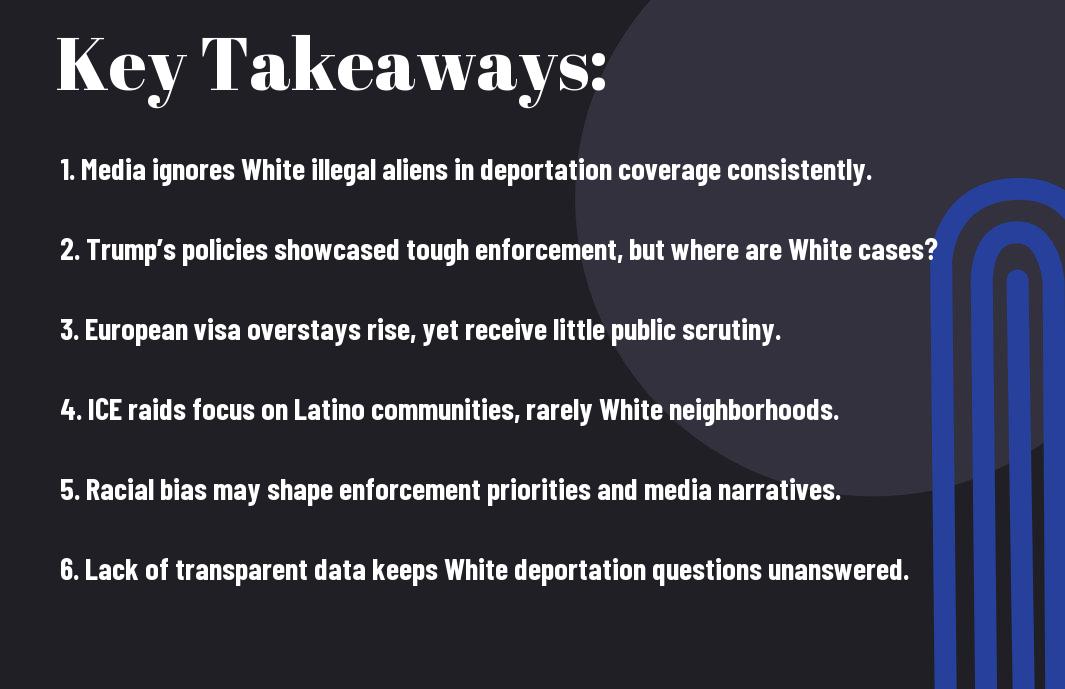
- Media and political narratives have long framed “illegal aliens” as predominantly Latino or non-European, leaving the presence of White undocumented immigrants largely invisible.
- Despite sizable numbers of visa overstays from European countries like the UK, Germany, and Canada, there’s a striking lack of public attention, ICE raids, or media coverage targeting White illegal aliens.
- Trump’s immigration enforcement was aggressive and highly publicized—but reports and stories of deportations involving White undocumented immigrants in major cities are almost nonexistent.
- This absence raises questions about possible racial bias in enforcement policies, selective media coverage, and whether White illegal aliens were overlooked or quietly protected during Trump’s presidency.
- Without transparent statistics breaking down deportations by race, the debate remains open-ended, fueling frustration about fairness and equal application of immigration laws.
The Complex Landscape of Illegal Immigration
Your understanding of illegal immigration broadens once you look beyond the usual portrayals. The reality involves a complex mix of nationalities, economic pressures, and enforcement inconsistencies. As you peel back the layers, you see how policy, media, and social biases intersect, shaping the public story—and how some groups, like White illegal aliens, often fly under the radar despite being part of the problem.
Understanding Illegal Immigration in America
Illegal immigration in America isn’t a one-size-fits-all issue. It includes diverse groups from Latin America, Asia, and Europe, with many entering legally but overstaying visas. You might not realize how many visitors from countries such as Canada, the UK, or Germany stay beyond their authorized periods, contributing significantly to the undocumented population.
- Illegal immigration involves both border crossings and visa overstays
- European nationals rank high among visa overstayers
- ICE enforcement often targets specific demographics
- Media coverage skews public perception towards Latino immigrants
- After understanding these points, you see the puzzle extends beyond borders
The Diversity of Illegal Immigrants: Beyond Common Stereotypes
The stereotypical image of illegal aliens often excludes many White immigrants who remain undocumented or overstay visas. You find people from Canada, Australia, Germany, and France living in the U.S. unlawfully, yet their cases rarely make headlines. Media and enforcement practices shape these blind spots, leaving you wondering how much bias influences public awareness.
- White illegal aliens include Europeans and other predominantly White nations
- Visa overstays by Europeans form a significant part of undocumented populations
- ICE raids focus on minority communities, not White neighborhoods
- Media silence around White deportations fuels perception gaps
- After recognizing this diversity, you question the fairness of enforcement and coverage
| Predominant Group | Undocumented Presence (Estimates) |
|---|---|
| Latino and Hispanic Immigrants | ~70% of total undocumented population |
| European Nationals (primarily White) | Thousands annually overstaying visas |
| Asian Immigrants | Significant but less publicized |
| Canadian and Australian Nationals | High visa overstay rates, low deportation visibility |
| Other Groups | Small minority with uneven data reporting |
Considering the wide range of undocumented immigrants, it becomes clear the issue isn’t just about illegal border crossings—it also involves visa overstays and selective enforcement. When you dig into the details, you realize that the narrative promoted in media leaves out many groups, particularly those from predominantly White countries. This omission has real implications for how you interpret immigration policy and fairness.
The Role of Economic Factors in Immigration Decisions
Economic opportunity remains a powerful motivator for illegal immigration, whether for a construction job in Ohio or high-skilled work in Silicon Valley. White immigrants from Europe and Canada often overstay visas seeking better income or lifestyle, just as others do. These economic factors fuel your expectations on why illegal immigration persists across racial and national lines.
- Economic disparities drive visa overstays
- Labor demand in various U.S. sectors attracts undocumented workers
- White illegal aliens often enter legally but overstay due to opportunity
- Enforcement focus seldom aligns with actual economic patterns
- Knowing this, you see the limits of purely legal or racial interpretations of illegal immigration
Most White undocumented immigrants enter the U.S. on temporary visas—tourist, business, student—and choose to remain beyond expiration, chasing economic gains. Unlike border crossings, this form of illegal presence is less visible, harder to detect, and often overlooked by ICE’s resource allocations. When you factor in these economic realities, it becomes obvious that immigration enforcement behaves inconsistently across groups, often ignoring where unauthorized stays thrive.
- Visa overstays prevalent among European tourists and students
- Economic incentives such as employment and education
- Limited ICE enforcement resources target more visible populations
- White illegal aliens are less likely to be profiled or deported
- Knowing enforcement gaps helps explain the silent presence of many White illegal aliens
Racial Dynamics of Illegal Immigration
The way illegal immigration is framed in America hinges heavily on racial perceptions, shaping enforcement and public opinion alike. You’ve seen how the media relentlessly spotlights Latino immigrants while largely ignoring White illegal aliens. This selective focus fuels the narrative that immigrant illegality is mostly about people of color, reinforcing stereotypes that affect policy decisions. Understanding these racial dynamics reveals how immigration law enforcement often intersects with racial bias, not just legal criteria.
The Perception of Race in Immigration Policies
Immigration policies frequently mirror societal views on race, with enforcement often harsher on non-White groups. White illegal aliens, especially from European countries, tend to be perceived as “less illegal” or less threatening, leading to lighter scrutiny or fewer deportations. This perception colors your understanding of who is targeted, feeding into a system where enforcement hinges more on racial identity than purely legal status.
The Historical Context of Immigration and Race in America
The history of American immigration is deeply entangled with race, dating back to laws explicitly designed to favor White immigrants through quotas and restrictions. Over centuries, immigration control served as a tool to preserve racial hierarchies, granting privileges to European arrivals while restricting others. This legacy still influences today’s enforcement disparities, explaining why White illegal aliens often face fewer obstacles.
You can trace this back to policies like the National Origins Act of 1924, which favored Northern and Western European immigrants, effectively shaping America’s racial demographic for decades. These early frameworks embedded racial preferences into the immigration system, setting patterns that persist in enforcement practices. Despite changing immigration sources, the echoes of these preferences linger in how laws are applied and who is scrutinized, often benefiting White undocumented immigrants.
Impacts of Racial Narratives on Policy Decisions
Racial narratives heavily influence which immigrant groups face aggressive deportations and which are overlooked. Portraying Latinos as criminals or security threats creates political pressure to enforce laws selectively, while White illegal aliens rarely fit into these narratives, sparing them from similar targeting. These perceptions shape enforcement priorities and resource allocation, affecting your community’s experience and the fairness of immigration policy.
Examining specific enforcement trends during the Trump era reveals a pattern where ICE concentrated efforts on Latino and Muslim communities, consistent with politically charged narratives about security and criminality. This focus diverted attention and resources away from White illegal aliens, who, despite significant visa overstays, saw comparatively minimal deportation actions. The result? A system where immigration policy enforcement becomes less about the law and more about controlling racialized perceptions.
White Illegal Aliens: Who Are They?
White illegal aliens are largely European immigrants whose visa overstays and undocumented statuses fly under the radar despite their substantial presence. Many come from countries like the UK, Germany, Canada, and France—nations with strong economic ties to the U.S. Unlike the stereotypical image of immigrants crossing southern borders, these individuals often enter legally via tourist or work visas and simply never leave, quietly becoming part of the undocumented population without attracting media attention or ICE enforcement drama.
Demographics of White Undocumented Immigrants
The majority of White undocumented immigrants are visa overstayers from wealthy, predominantly European countries. Data reveals thousands from places like Ireland, Italy, and Poland overstay annually, though exact numbers are murky due to limited racial breakdowns in deportation stats. You’re looking at a demographic generally well-educated, English-speaking, and often residing in metropolitan or suburban areas where they blend into the local milieu, avoiding the more visible immigrant enclaves tied to Latin American communities.
Common Myths About White Illegal Aliens
A widespread myth claims White illegal aliens are virtually nonexistent or always legal because they come from prosperous nations. Another fallacy assumes they face the same risk of deportation and enforcement as other undocumented groups. In truth, these myths obscure the reality that visa overstays by White nationals form a significant chunk of the undocumented population and that enforcement and media attention around them remains minimal.
Digging deeper, one sees that White illegal aliens differ sharply in public perception and treatment. Unlike high-profile raids targeting Latino communities, these immigrants rarely face large-scale ICE operations. The “secure borders” rhetoric largely sidelines them, which fuels the perception of selective enforcement. The prevailing myths conveniently mask systemic discrepancies and hinder honest dialogue about immigration fairness and policy enforcement.
Geographic Concentrations of White Illegal Aliens
White undocumented immigrants tend to cluster in urban and suburban hubs with well-established European diaspora populations. Places like Washington DC, Chicago, Ohio, and Indiana report noticeable numbers of White overstayers. Their residence patterns overlap with affluent neighborhoods, university towns, and business centers, making them less conspicuous and reducing high-visibility enforcement compared to Latino-heavy communities along the southern border.
Moreover, these geographic concentrations reflect certain economic and cultural ties that ease the process of visa acquisition and overstay. For example, tech corridors in the Midwest and government employment hubs in DC attract many White immigrants who quietly overstay. This contrasts with border states where enforcement is blistering and public awareness is heightened, deepening the divide in who faces immigration crackdowns and how the media frames each group.
Trump’s Immigration Policies: An Overview
Trump’s immigration approach was unapologetically hardline, promoting a narrative of strict law enforcement and border security. You saw sweeping ICE raids, heightened deportations, and restrictive travel bans, all framed as undeniable proof of toughness. Yet, this aggressive stance oddly didn’t translate into visible enforcement against White undocumented immigrants in your typical Midwestern or East Coast cities. The stark contrast between the attention given to Latino immigrants and the silence around European overstayers raises questions about the true consistency of these policies.
Key Policies Implemented During the Trump Administration
The Trump administration launched several landmark measures: the Mexico border wall’s expansion, expanded ICE detention and deportations, and restrictive travel bans targeting Muslim-majority countries. The “zero tolerance” policy led to family separations, and the Public Charge Rule limited immigration access based on economic factors. Yet, despite these sweeping initiatives, enforcement data rarely spotlighted visa overstays by Europeans or Canadians, leaving you wondering if selective focus shaped the policy’s real impact.
The Rhetoric of Enforcement: A Focused Narrative
Public messaging relentlessly zeroed in on Latino immigrants and Muslim travelers as the face of illegality and threat. The media, backed by administration statements, painted a vivid picture of southern border chaos and national security risks, effectively sidelining White undocumented immigrants. This narrative shaped your perception heavily, making the deportation of European or White illegal aliens seem almost nonexistent despite evidence to the contrary.
Digging deeper, the focused narrative conveniently aligned with political goals. By spotlighting Latino and Muslim immigrants, the administration galvanized its base while diverting attention from other enforcement areas. The absence of stories on White overstayers wasn’t just media oversight but a systematic sidelining. This framing influenced law enforcement priorities and public opinion, crafting an immigration crisis image that selectively portrayed who was deemed “illegal” and who was invisible.
The Role of Executive Orders in Shaping Immigration
Trump leaned heavily on executive orders to bypass congressional gridlock, accelerating immigration policy shifts overnight. Orders like the border wall funding directive and expanded ICE authority reshaped enforcement mechanics rapidly. However, these orders rarely specified enforcement details by nationality or race, leaving broad discretion that may have fueled uneven application affecting White undocumented immigrants differently than others.
Executive actions empowered ICE and DHS to prioritize certain immigrant groups, ostensibly for resource efficiency, but this blurred legal consistency. You’d find policies on paper broad, but in practice, implementation often targeted specific demographics. The ambiguity in executive orders created opportunities for selective enforcement patterns—where European overstayers could slip under the radar—while spotlighting Latino communities for deportation, effectively institutionalizing disparities without explicit directives.
Disproportionate Impact on Communities of Color
The aggressive immigration enforcement under Trump disproportionately targeted immigrant communities of color, exposing deep-rooted disparities in policing and deportations. Latino neighborhoods in cities like Los Angeles and Houston faced relentless ICE raids, while similar actions in predominantly White areas remained nearly nonexistent. This uneven enforcement reinforced a narrative that illegal immigration is a problem almost exclusively linked to non-White populations, contributing to fear, mistrust, and a sense of injustice in communities already navigating socioeconomic challenges.
ICE Raids: Targeting Vulnerable Communities
ICE raids overwhelmingly struck Latino and immigrant communities of color, often using workplaces and homes as points of entry. For example, the 2017 raid in Mississippi slaughterhouse swept up over 600 mostly Latino workers, decimating families and local economies. These actions created a chilling atmosphere where entire neighborhoods lived in fear, knowing that enforcement did not equally extend to White immigrants in other states or communities, further fueling perceptions of a racialized immigration crackdown.
Media Representation of Immigrants of Color

Mainstream media relentlessly portrayed immigrants of color as the face of illegal immigration, amplifying stories of ICE raids, arrests, and border crossings. This framing shaped public opinion, linking immigration with crime and lawlessness, while White undocumented immigrants were largely absent from headlines. Such skewed representation reinforced stereotypes that disproportionately stigmatized Latino and non-White immigrants, obscuring the complex realities of immigration enforcement and its selective visibility.
Beyond the headlines, media narratives have often framed the immigration debate through a racial lens, spotlighting Latinos and other minorities while sidelining White undocumented immigrants who quietly overstay visas or reside illegally without attracting the same scrutiny. News coverage fixates on dramatic raids and criminal cases in predominantly Brown communities, imprinting a one-sided image that supports certain political agendas. This selective spotlight not only distorts public perception but perpetuates a cycle where immigrant communities of color bear the brunt of societal and legal condemnation.
The Personal Stories Behind the Statistics
Beyond numbers and news clips lie personal stories marked by loss, separation, and resilience in immigrant communities of color. Families torn apart during ICE raids, children suddenly without parents, workers losing livelihoods—these realities give a human face to enforcement disparities. Meanwhile, similar narratives rarely surface in White undocumented immigrant communities, further obscuring their experiences and making the unequal impact harder to grasp.
Diving deeper into these personal accounts reveals a pattern of trauma and disruption heavily concentrated in Latino and Black immigrant neighborhoods. For instance, following the 2018 raid at a poultry plant in Tennessee, dozens of children were left without caregivers as parents faced deportation. Such human costs rarely make national headlines when White undocumented immigrants face legal challenges, underscoring a racial divide not just in enforcement but also in whose stories gain empathy and attention.
The Silence on White Illegal Aliens
A striking absence marks the conversation around undocumented immigration: White illegal aliens rarely appear in headlines or law enforcement narratives. While ICE arrests in Latino communities grab front-page news, similar actions in predominantly White areas like parts of Ohio or Indiana are practically invisible. You’re left wondering whether this silence stems from deliberate oversight, racial profiling, or media convenience. The invisibility of White undocumented immigrants in public discourse highlights a selective focus that shapes what you see and hear about immigration enforcement.
Media Coverage of White Undocumented Immigration
Media outlets almost never spotlight deportations involving White undocumented immigrants. Stories about Canadian or European visa overstays rarely make news, despite these groups comprising thousands of cases each year. This selective storytelling creates an invisible category of White illegal aliens who quietly overstay visas or live undocumented without public scrutiny. The lack of sensational headlines or viral videos reveals how the media shapes the narrative, emphasizing certain ethnicities while sidelining others.
Political Discourse: Exclusion of White Illegal Aliens
Political rhetoric around immigration during Trump’s tenure almost exclusively targeted Latin American and Muslim-majority groups, framing them as threats while barely acknowledging undocumented White immigrants. Politicians and policymakers emphasized border walls and ICE raids in communities of color, with little to no mention of European or Canadian overstayers. This omission reinforces a selective political focus that excludes White illegal aliens from immigration debates and underscores the role of political agendas in shaping what you are told about immigration enforcement.
This exclusion isn’t accidental; it reflects how political discourse molds public priorities. By focusing on Latino and Muslim immigrants, politicians rallied support through fear and controversy, while ignoring cases that might complicate their narrative. White undocumented immigrants rarely fit these politically useful archetypes, so they become invisible in speeches, policy proposals, and public debates. The absence of this group from political conversations tacitly suggests they are a lesser priority or even overlooked, reinforcing disparities you might not have noticed but that affect enforcement outcomes.
Cultural Narratives and Their Role in Public Perception
Cultural narratives overwhelmingly depict “illegal aliens” as dark-skinned, often Spanish-speaking individuals crossing southern borders. This widespread imagery excludes White illegal aliens from public perception, making their existence seem negligible or nonexistent. These ingrained stereotypes influence how you interpret immigration stories, which ethnic groups are vilified, and which are ignored, creating a distorted view of America’s undocumented population.
These narratives are powerful because they tap into long-standing social constructs about race and belonging. By framing illegal immigration almost exclusively as a “Brown issue,” media and popular culture create boundaries around who is perceived as “other.” This exclusion shapes your understanding, enabling the broader public and policymakers to overlook White illegal aliens, who “blend in” more easily and do not fit the expected image of an undocumented immigrant. The result is a cultural blinder that influences everything from enforcement practices to public empathy.
Administrative Discretion and Its Effects
You need to understand that immigration enforcement isn’t a mechanical process; it involves layers of discretion at multiple levels. ICE officers decide who gets prioritized for deportation, and these decisions can reflect institutional biases. Administrative discretion means that enforcement often skirts clear-cut legal criteria and instead follows unwritten practices shaped by politics, local pressure, and resource allocation. This discretion inevitably impacts which undocumented immigrants face removal actions—and which quietly remain under the radar, including many White illegal aliens whose cases rarely make headlines or political fodder.
How ICE Prioritizes Deportation Targets
ICE targets primarily focus on individuals labeled as threats to public safety or national security, including those with criminal convictions. However, enforcement guidelines during the Trump era became increasingly aggressive toward Latino populations, while enforcement against White illegal aliens—often visa overstayers from Europe or Canada—appeared less urgent and less publicized. This selective prioritization means you’re less likely to see ICE raids or deportation stories involving White undocumented immigrants, despite substantial visa overstay figures from predominantly White countries.
The Influence of Local Law Enforcement on Immigrant Communities
Local law enforcement plays a significant role in immigration enforcement by cooperating or resisting ICE operations. Cities with “sanctuary” policies often restrict such cooperation, reducing deportation rates among all immigrant groups. Conversely, local police in majority Latino neighborhoods frequently collaborate with ICE, amplifying enforcement. Meanwhile, in predominantly White communities, local agencies may be less inclined to assist or publicize immigration crackdowns, shielding White illegal aliens from intense scrutiny and enforcement actions.
You’ll find that in metropolitan areas like Chicago or Washington DC, enforcement focus heavily aligns with local demographics and political climates. In heavily Latino neighborhoods, ICE raids and arrests are widely publicized and aggressively pursued. Yet in predominantly White suburbs or communities, local law enforcement’s minimal collaboration or lower prioritization results in fewer enforcement actions against White illegal aliens. This uneven cooperation creates enforcement disparities that shape public perception about who actually faces immigration consequences.
Case Studies: Enforcement Actions Against White Illegal Aliens
Documented cases of ICE enforcement against White illegal aliens during Trump’s presidency are sporadic and largely low-profile compared to Latino-focused operations. Still, public records show that White visa overstayers and European nationals were subject to deportation, albeit less frequently and with less media attention. These cases often involve individuals with aggravated criminal histories or repeated immigration violations, indicating enforcement thresholds that differ by demographic.
- In 2018, ICE reported approximately 3,500 deportations of European nationals, including from the UK, Germany, and Poland, primarily for visa overstays and criminal records.
- Between 2017 and 2019, Ohio and Illinois saw fewer than 200 recorded deportations of White undocumented immigrants, contrasted with thousands from Latino countries in the same states.
- Data from ICE in 2019 shows that only 12% of all deportations in Chicago involved European nationals, while Latino nationals composed over 70%.
- ICE enforcement reports reveal that visa overstays—a common status among White illegal aliens—receive lower priority versus convictions for violent crimes, disproportionately affecting non-Latino groups.
While these figures prove that White illegal aliens faced enforcement, you must notice the stark numerical and publicity gap compared to Latino deportations. The cases often lack broad media coverage or dramatic ICE raids, points that fuel the perception of a “free pass.” Instead, enforcement appears calculated, with selective visibility and varying thresholds of action—offering insight into how race and narrative influence ICE’s operational choices under Trump.
- 2018 ICE Annual Report: 3,527 deported Europeans, mainly visa overstayers and criminal cases.
- Illinois Deportation Data (2017-2019): 182 White undocumented immigrants deported, versus 7,114 Latino nationals.
- Chicago ICE Enforcement (2019): European nationals made up 12% of deportations, compared to 70% Latino nationals.
- Visa Overstay Prioritization: Lower enforcement emphasis on visa overstayers, a status common among White illegal aliens.
The Economic Contributions of White Undocumented Immigrants

White undocumented immigrants make notable but often overlooked economic contributions across the U.S., particularly in sectors like technology, agriculture, hospitality, and healthcare. Despite visa overstays and undocumented status, many fill labor shortages, pay taxes, and support local economies. Their presence challenges the simplistic media portrayals you’ve seen, revealing a more complex labor dynamic where undocumented European nationals sustain vital industries quietly and consistently, yet receive minimal public acknowledgment.
Labor Market Involvement of White Illegal Aliens
White illegal aliens frequently work in skilled and semi-skilled positions less visible in immigration narratives. For example, many European visa overstayers hold jobs in IT, restaurants, or seasonal farming, contributing to industries facing labor gaps. Reports indicate up to 10% of undocumented European immigrants engage in niche professions where their “white” identity facilitates easier assimilation and less scrutiny compared to other undocumented groups.
The Contributions to Local Economies
In cities like Chicago and Washington DC, undocumented White immigrants inject capital through consumer spending, rent payments, and small business startups. Their economic footprint supports neighborhoods that would otherwise struggle, subtly enhancing economic diversity without drawing public or media attention.
Digging deeper, these contributions translate into millions in sales tax revenue and property taxes annually, even as many White illegal aliens remain invisible in official economic studies. For example, Canadian visa overstayers frequently fill high-demand hospitality roles, driving both employment and local service economies in tourist-heavy regions. Their economic integration often offsets labor shortages and underpins sectors vital to urban growth, especially in Midwest and East Coast cities.
Challenges Faced by White Illegal Aliens in Economic Integration
White undocumented immigrants may experience fewer enforcement actions, but economic integration isn’t seamless. Many face barriers such as limited access to banking, lack of legal work authorization, and vulnerability to exploitation given their undocumented status. These hurdles constrain their ability to fully leverage their economic potential.
Beyond legal restrictions, the invisibility of White illegal aliens in public discourse creates a unique challenge: limited advocacy and support networks. Unlike other immigrant communities where nonprofits and legal services focus on integration, European undocumented immigrants often navigate economic instability largely on their own, without formal protections or community resources tailored to their needs.
Comparing Measuring and Data Reporting
| Data Measurement | Data Reporting |
|---|---|
| Typically aggregates deportation figures by nationality rather than race or ethnicity, obscuring racial patterns. | Government and media reports prioritize nationality, rarely highlighting the skin color or ethnic background of deportees. |
| Visa overstay data lists countries such as the UK, Germany, and Canada but does not distinguish by race or visible immigrant communities. | Press coverage favors sensational stories involving non-White immigrants, leaving White illegal aliens largely unreported. |
| ICE enforcement actions focus heavily on Latino immigrant populations, inflating their visibility in deportation statistics. | No consistent or transparent data breakdown exists nationwide for deportations involving White illegal aliens, making comparison difficult. |
Analyzing Deportation Statistics by Race
The absence of deportation data broken down by race leads you to rely on nationality as a proxy, which can be misleading. European nationals from countries like Ireland and Poland routinely overstay visas but do not surface prominently in deportation headlines. This gap suggests enforcement either disproportionately targets non-White groups or selectively reports on them. Without comprehensive racial analysis, the full scope of White undocumented immigrant deportations remains hidden, leaving you with an incomplete and biased picture of immigration enforcement under Trump.
The Reluctance to Disaggregate Data by Ethnicity
Disaggregating deportation data by ethnicity or race remains an avoided step in official reporting. The reasons are political and practical: governments shy away from exposing racial enforcement disparities that could spark controversy, while enforcement agencies prefer aggregated nationality data that dilutes racial focus. This reluctance intentionally or incidentally keeps White illegal aliens under the radar, denying you clarity on whether selective enforcement or racial bias shapes immigration policies.
The hesitation to break down data further also stems from logistical challenges; collecting and verifying ethnicity or race involves privacy concerns and administrative burdens. However, this avoidance fuels mistrust and speculation, allowing narratives of unequal treatment to take root. Without transparency, you’re left guessing if White illegal aliens benefit from invisible exemptions embedded within enforcement bureaucracy.
The Impact of Data Collection Practices on Public Understanding
Your understanding of immigration enforcement is shaped by the data available—and when data fails to differentiate by race or ethnicity, it skews public perception. You end up equating deportation with certain immigrant communities, ignoring others simply because their cases are hidden in aggregated datasets. This disconnect fosters misunderstanding, erodes trust in the fairness of enforcement, and feeds the perception that some illegal aliens receive preferential treatment under Trump’s policies.
These opaque data practices not only shape media narratives but also influence public debate and policymaking. When deportation figures lack racial detail, activists, journalists, and citizens can’t effectively challenge potential biases or demand accountability. As a result, you face a one-sided portrayal that hampers efforts to achieve impartial immigration reforms and fuels lingering resentment about unequal enforcement.
Public Opinion and Its Influence on Immigration Policy
Public opinion wields hidden power over the immigration policies you see enacted. Politicians and agencies respond not only to legal mandates but to the loudly voiced concerns—or indifference—of voters. When media and public discourse spotlight certain groups as the “face” of illegal immigration, resources and enforcement tactics often shift accordingly. This shaping of priorities can mean that realities like White illegal aliens’ relative invisibility in headlines and public outrage directly influence which communities face intense scrutiny—and which quietly avoid it.
The Role of Polling in Shaping Immigration Discourse
Polling data often sets the tone for debates on immigration by quantifying public fears and preferences. Surveys showing a majority of Americans perceiving illegal immigration as a problem primarily linked to Latino or non-European populations reinforce existing stereotypes. These findings, in turn, encourage policymakers to focus enforcement efforts and media attention on those groups rather than White illegal aliens. This cyclical feedback loop cements the narrative, making you less likely to hear about visa overstays or undocumented immigrants from Europe or Canada, despite their measurable presence.
Misconceptions About White Illegal Aliens in American Society
Many assume White immigrants either enter legally or aren’t part of the undocumented population, a misconception fueled by the lack of visible enforcement in predominantly White communities. You rarely hear stories about Canadians, Germans, or Australians overstaying visas or facing deportation—yet their numbers are significant. This selective visibility feeds the false narrative that undocumented immigration is a problem exclusive to brown-skinned foreigners, obscuring the reality of widespread visa overstays from European nations.
White illegal aliens often evade public scrutiny because their undocumented status clashes with ingrained stereotypes about immigration. Media coverage tends to spotlight immigrants with darker skin, casting a shadow over issues that involve White overstayers or unauthorized workers. For instance, Canada alone contributes thousands of visa overstays annually, yet arrests or deportations in these communities barely make headlines. This disconnect leaves you with an incomplete picture, one skewed by racialized preconceptions rather than objective enforcement realities.
The Connection Between Perception and Policy Reform
The policies you see enacted or debated often follow the contours of public perception rather than hard data alone. When the collective focus zeroes in on certain immigrant groups, reforms frequently target those communities while others remain under-addressed. This selective pressure shapes legislation, enforcement priorities, and funding allocations, reinforcing the cycles of disparity you notice. Without a shift in perception, White illegal aliens remain a blind spot for both policymakers and the media.
Understanding how perception drives policy reveals why comprehensive immigration reform stalls. Efforts tend to cater to the loudest narratives, sidelining nuanced realities like visa overstays from European countries. Policymakers respond more to voter outrage and media framing than detailed deportation statistics, so unless you challenge the dominant narrative, policies won’t fully reflect enforcement equality. As pressures mount on heavily targeted groups, other undocumented populations continue to slip through the cracks unnoticed.
Exploring Sanctuary Policies and Their Impact
Sanctuary policies have quietly shaped enforcement priorities across various states and cities, creating a patchwork of protections that often go unexamined—especially regarding White illegal aliens. While these policies aim to shield undocumented immigrants from federal deportation efforts, their inconsistent application raises questions about who benefits most. Some sanctuary jurisdictions have effectively limited cooperation with ICE, unintentionally or deliberately buffering White undocumented immigrants from deportation, while heavily policing communities of color. Understanding this uneven landscape helps you grasp why certain populations appear shielded and others relentlessly pursued.
The Concept of Sanctuary Cities and States
Sanctuary cities and states restrict local law enforcement from cooperating fully with federal immigration authorities, often refusing to honor ICE detainer requests without proper cause. Cities like San Francisco, Chicago, and New York lead this movement, promoting trusts between immigrant communities and local police. Yet, enforcement tends to be selective, sometimes resulting in de facto protection for White illegal aliens who “blend in” within these jurisdictions. These policies, intended to protect vulnerable immigrants, end up reflecting complex dynamics where visibility and race influence who faces deportation risks.
Legal Protections for White Illegal Aliens
White illegal aliens have sometimes found themselves under less scrutiny partly due to informal protections within sanctuary policies and a lack of targeted ICE operations in predominantly White neighborhoods. Additionally, visa overstays from countries like Canada, Germany, and the UK often slip through the cracks of enforcement, as local agencies prioritize other demographics. These gaps in enforcement amount to a de facto safety net, reducing the likelihood of deportation for many White undocumented immigrants compared to their non-White counterparts.
Diving deeper, legal protections for White illegal aliens manifest not only in sanctuary jurisdiction policies but also through systemic enforcement biases. For example, ICE’s internal priorities historically focused on recent border crossers or individuals with criminal records, demographics disproportionately Latino or from other non-White backgrounds. Meanwhile, visa overstays—predominantly from European nations—receive less attention. White immigrants often reside in suburban or affluent areas less frequented by ICE raids, further diminishing enforcement presence. This combination of enforcement discretion and sanctuary policies contributes significantly to why you rarely see publicized deportations of White illegal aliens.
Controversies and Challenges Surrounding Sanctuary Policies
Sanctuary policies stir intense debate, with critics arguing they foster unequal application of immigration laws—allowing certain undocumented immigrants, often White, to evade deportation while communities of color face harsh enforcement. Advocates claim these policies protect vulnerable immigrants from undue detention and family separation. However, the tension remains over fairness and consistent law application, especially in light of perceived racial disparities that fuel claims of selective justice. Questions about accountability and transparency within sanctuary jurisdictions continue to linger.
One contentious issue is how sanctuary policies intersect with race and enforcement priorities. While designed to protect immigrant communities broadly, these policies sometimes inadvertently create disparities that undermine equal protection principles. For instance, ICE data reveals a disproportionate focus on Latino populations, even in sanctuary cities, while White illegal aliens often experience less enforcement pressure. This selective implementation fuels political and social divides, making sanctuary policies both a shield and a lightning rod for criticism. Addressing these challenges requires confronting the complex interplay of race, law enforcement discretion, and public perception surrounding immigration enforcement.
Grassroots Movements and Advocacy
Grassroots groups have increasingly challenged the uneven spotlight on immigration enforcement, calling out the disparity between media portrayals and actual deportation practices. You’ll find activists in Midwestern cities like Chicago and Detroit demanding more transparent, equitable enforcement policies, especially highlighting how White undocumented immigrants often escape scrutiny. These community-driven efforts aim to expose both selective ICE targeting and media bias, pushing for reforms that hold all undocumented immigrants to the same legal standard, regardless of race or nationality.
Activist Responses to Perceived Inequities
Activists have mobilized around the perceived racial double standards in deportation, spotlighting how Latino communities bore the brunt of Trump’s ICE raids, while White undocumented immigrants went largely unnoticed. Groups like the National Immigration Justice Center have filed complaints and organized protests asserting that this selective targeting amounts to institutional bias. Their efforts draw attention to systemic disparities in enforcement and demand accountability from policymakers and law enforcement agencies alike.
Engaging Communities in Advocacy Efforts
Effective advocacy hinges on bringing together diverse communities affected by immigration enforcement, bridging gaps between Latino populations, immigrant Europeans, and mixed-race groups. Organizations such as Families for Freedom deploy multilingual outreach programs, legal clinics, and town halls to engage and educate residents on their rights, regardless of background. By expanding participation beyond traditionally visible immigrant groups, these efforts aim to dismantle narratives that isolate White illegal aliens from broader immigration justice conversations.
Engagement strategies often include forming coalitions that cross geographic and ethnic lines—for example, linking Midwest-based immigrant advocacy groups with European immigrant support networks in states like Ohio and Indiana. These coalitions leverage data-sharing and joint campaigns to highlight how visa overstays and undocumented presence exist across racial lines. They utilize social media platforms, local media outlets, and community influencers to humanize undocumented individuals from all origins, making advocacy more inclusive and effective in reshaping public perception and policy priorities.
Future Directions for Advocacy Related to Immigration
Looking ahead, advocacy is likely to focus on securing transparent data reporting that breaks down deportation by race, nationality, and even visa status to close existing information gaps. Campaigns will push not only for equitable enforcement but also for media accountability in storytelling. You can expect a stronger emphasis on policy reforms that eliminate enforcement loopholes and prioritize family unity, regardless of racial or ethnic background.
Future advocacy efforts will incorporate technology-driven data analysis to challenge ICE’s selective enforcement patterns, supporting litigation that targets racial profiling in deportation practices. Grassroots organizers plan to partner more closely with academic institutions to produce evidence-based reports, supplying legislators and the public with hard facts that weaken selective narratives. This evolution in strategy intends to reshape immigration discourse to be far less about sensationalism and far more about fairness and rule of law for all undocumented immigrants.
The Consequences of Perceived Inequities
Perceptions of unequal treatment in immigration enforcement don’t just fuel debates—they shape real-world outcomes. When certain groups sense they’re being singled out or others are given silent passes, it deepens social divides and fosters resentment. These perceived inequities ripple beyond individual cases, impacting how communities interact with law enforcement, media, and the government itself. Ignoring these effects risks eroding trust and stability in already fragile social fabrics.
Psychological and Emotional Effects on Affected Communities
If you belong to a community frequently targeted for harsh immigration crackdowns, you know the toll it takes on personal and collective well-being. Anxiety, fear, and feelings of injustice mount as families live under constant threat, while witnessing other groups seemingly spared from similar scrutiny. This emotional strain often translates into mistrust, social withdrawal, and a diminished sense of safety in your own neighborhood.
Growing Distrust Towards Government Institutions
When deportations disproportionately spotlight certain groups, many start questioning whether enforcement is truly about law or selective bias. Communities affected by heavy ICE raids grow skeptical of fairness, doubting if government agencies serve all citizens equally. This skepticism undermines cooperation, compliance, and faith in institutions tasked with upholding justice and public safety.
Distrust escalates when you see no transparent data clarifying if enforcement policies reflect equal application of the law or arbitrary targeting. Without accountability, some begin to suspect that political considerations influence who faces detention or deportation, deepening cynicism. This erosion of trust not only strains relationships with immigration authorities—it bleeds into broader confidence in governmental legitimacy.
The Potential for Social Unrest and Division
Perceptions of unequal justice can ignite tensions that stretch beyond immigration debates, fueling divisions across racial and socio-economic lines. Communities who feel ignored or unfairly targeted may express their grievances through protests, heightened vocal opposition, or withdrawal from civic engagement, destabilizing social cohesion.
When you witness disparities that seem rooted in race or ethnicity, it feeds narratives of systemic injustice that resonate powerfully within disenfranchised groups. These feelings can fracture alliances and deepen cultural fault lines, making it harder to build consensus around immigration reform or broader policy solutions. In some cases, this division gives rise to heightened political polarization and spikes in confrontational activism.
Further Research and Required Actions
The glaring gaps in data about White illegal aliens call for a serious overhaul in how immigration enforcement and media coverage intersect. You can’t fully grasp the breadth of the issue without digging into race-specific deportation statistics, analyzing enforcement patterns, and critically examining how narratives get shaped. Without this foundational transparency, policies remain vulnerable to bias—intentional or not—and public trust erodes. Moving beyond assumptions requires hard facts and a commitment to exposing the full picture, no matter how uncomfortable it may be.
Areas Needing More Comprehensive Study
You need detailed data that breaks down deportation rates by race and ethnicity, not just by nationality. For example, a deeper look into visa overstays from countries like Canada, Germany, and the UK could reveal enforcement disparities. Studies comparing ICE raid frequency in predominantly White versus Latino communities will show if enforcement is truly even-handed or skewed. Cross-referencing immigration data with demographic maps of cities like Chicago or Washington DC can highlight patterns that have been ignored or suppressed—offering you the insights policymakers and media overlook.
The Role of Academics and Research Institutions
Academic institutions have a unique responsibility to provide unbiased, rigorous analysis of immigration enforcement data. They can expose enforcement biases by leveraging sophisticated methodologies, such as statistical modeling and ethnographic research, which go beyond superficial reporting. By publicizing peer-reviewed studies on how race affects immigration policy application, universities and think tanks can equip you, the public and decision-makers, with evidence-based insights that push for equal justice under the law.
These institutions possess the tools and credibility to challenge official narratives by conducting longitudinal studies that track deportation trends over multiple administrations, disaggregating data by race, region, and offense type. Collaborating with civil rights organizations and community groups further enriches their research, connecting abstract data to real human experiences across different racial and ethnic populations. This collaboration ensures that their findings resonate beyond academia and trigger meaningful policy debates and reforms.
Advocating for Transparency in Immigration Policies
Transparency must move beyond slogans and become a hard policy requirement enforced through legislative or executive action. You should demand ICE and DHS publish detailed enforcement data that includes racial and demographic breakdowns. Clear public reporting fosters accountability, deters discriminatory practices, and helps ensure the immigration system operates fairly, not selectively.
Calls for transparency are gaining momentum with reform advocates pushing for accessible databases that track deportation targets in real time. This kind of openness not only shines a spotlight on potential racial disparities but also empowers communities and watchdog groups to hold agencies accountable. By forcing immigration authorities to reveal their enforcement algorithms, criteria, and decision-making processes, you can challenge opaque policies that might otherwise perpetuate systemic inequities.
FAQ
Q: Were White illegal aliens deported less frequently during the Trump administration compared to other groups?
A: Official data often breaks down deportations by nationality rather than race, making it difficult to draw a clear line. However, multiple reports and media observations suggest that deportations and ICE raids were heavily concentrated in Latino and Muslim-majority communities, while White undocumented immigrants, often from European countries, appeared to face less visible enforcement. This absence of coverage and apparent disparity feeds speculation that White illegal aliens were either overlooked or intentionally deprioritized.
Q: Is the lack of media coverage on White illegal aliens being deported a sign of racial bias?
A: Many argue that media coverage tends to sensationalize cases fitting existing social narratives—primarily those involving Latino or non-European immigrants—while underreporting or ignoring deportations involving White undocumented immigrants. This selective attention can create a perception of racial bias or an unspoken double standard, regardless of the actual enforcement policies in place.
Q: Could White illegal aliens simply be a smaller portion of the undocumented population, explaining their lower deportation visibility?
A: While the undocumented population is heavily weighted toward immigrants from Latin America, visa overstays from European and other predominantly White countries are significant and consistently ranked among the top nationalities overstaying. The issue is less about numbers and more about why these cases rarely receive public attention or aggressive enforcement comparable to other groups.
Q: Did the Trump administration’s immigration policies specifically exclude or protect White illegal aliens?
A: There is no official evidence or policy explicitly exempting White undocumented immigrants from enforcement. However, critics suggest that the administration’s intense focus on border control, travel bans targeting Muslim-majority countries, and the media spotlight on Latin American deportations created a de facto priority system. This may have left many White illegal aliens “under the radar,” either by design, political strategy, or enforcement resource allocation.
Q: What impact does the perceived disparity in immigration enforcement have on public trust and fairness?
A: The perception that White illegal aliens receive more lenient treatment fuels frustration and feelings of injustice among communities heavily targeted by ICE raids and deportations. Questions about equal protection under the law arise, raising concerns about whether immigration enforcement serves legal principles or is influenced by racial and political considerations. This emotional divide feeds ongoing debates around fairness, transparency, and accountability in immigration policy.

About the author


Understanding Allodial Titles, Land Patents, and Their Legal Implications
In property rights and land ownership, the concepts of allodial titles and land patents hold significant legal weight. These terms are often used in discussions related to the protection of property rights, land ownership, and the interplay between various areas of law such as the Uniform Commercial Code, contract law, constitutional law, and statutory law. In this in-depth blog post, we will explore into the intricacies of allodial titles and land patents, exploring their definitions, legal implications, and dispelling common myths and misconceptions associated with them. Key Takeaways: Allodial Titles Explained: An allodial title represents the highest form of land ownership, granting the owner absolute and unburdened ownership of the property, free from any encumbrances, liens, or taxes imposed by external parties. Land Patents and Their Legal Implications: A land patent is a legal document issued by the government that […]

Outsmart the System: Top Legal Strategies You Need to Know
Understanding the Legal Landscape While the legal system may seem intimidating, grasping its core concepts can empower you to navigate its complexities effectively. Understanding this landscape is vital for anyone looking to outsmart the system and optimize their legal strategies. Whether you’re seeking legal hacks for small businesses or tips on how to use legal loopholes to your advantage, recognizing the different legal frameworks at play can be crucial in making informed decisions. Overview of Legal Systems An understanding of the various legal systems is pivotal for recognizing your rights and obligations. Legal frameworks can vary significantly from one country to another, with common systems including civil law, common law, and religious law. Each system has its own structure, offering unique legal strategies and challenges. For example, in a common law system, previous judicial decisions can influence future cases, allowing […]

Ilataza Ban Yasharahla EL’s Public Records Request for Elyria Board of Education
24-0001492: Ilataza Ban Yasharahla EL's Public Records Request for Elyria Board of Education. All Rights Expressly Reserved and Retained. https://nationalnoticerecord.com/elyria-boe-members-required-to-follow-rulings https://nationalnoticerecord.com/is-elyria-school-board-bound-by-ohio-courts https://nationalnoticerecord.com/understanding-the-oath-of-office-legal-obligations-and-consequences

Ohio Legalizing Recreation Marijuana Use May Hurt Dispensaries in Monroe, Michigan
In recent years, the movement to legalize marijuana for adult recreational use has gained significant momentum across the United States. Ohio, a state long synonymous with conservative values, has also embraced this shift in public opinion. With the passing of Ohio Issue 2 and the Ohio Home Grow Bill, the state has joined the ranks of those allowing the recreational use of marijuana. This blog post will delve into the pros and cons of Ohio's legalization, as well as the potential implications for marijuana dispensaries in Monroe, Michigan, which previously benefited from Ohio buyers crossing state lines. https://www.youtube.com/watch?v=0KRzqZ8dUwc Pros of Ohio's Recreational Marijuana Legalization 1. Economic Boost: Legalizing recreational marijuana in Ohio has the potential to generate substantial economic benefits for the state. The marijuana industry has proven to be a lucrative market, with tax revenue and job creation being […]

The Etymology of “Bey” EXPOSED
TURN UP YOUR VOLUME & PRESS PLAY Have you ever wondered what the true origin and meaning of "Bey" is? We've been told that it means "Governor", "Law Enforcer", Chief, etc. But, what if that's incorrect? What if we've been using the "title", "Bey", incorrectly? FILL OUT THE FORM TO GET STARTED First Name: Last Name: Phone Number: Email: I agree to receive email updates and promotions. Submit

Are You A “Colored Person”?
Tune in as we dissect the term "person of color", exposing how its PURPOSELY steeped in plausibility, DECEPTION, and used as a weapon.

We’ve Been FORCED to Make Some Changes
Due to receiving so many tasks that our work has become more tedious, we've been forced to make some changes at National Notice Record.

Gas Go Express Food Mart Unjust Enrichment Via Debit Card Surcharge Fees
https://www.youtube.com/watch?v=eJknhtE9JEI In this video, I talk about a consumer experience I had while shopping at Gas Go Express Food Mart Gas Station, located at 237 Lake Avenue, Elyria, Ohio. On November 24, 2021, I made a purchase for 4 taxable items at the location. Each item was $0.99 per. With taxes, it came up to $4.26. As I got ready to place my debit card into the card reader, the Gas Go Express Food Mart clerk immediately added a $.50 debit card surcharge fee. As a common practice, some merchants/stores add a surcharge to your total purchase amount when you spend less than $5 or $10 when using a credit/debit card to process the payment. Being a merchant myself, I know that Master Card, Visa, Discover, and some of the other financial institutions have a strict policy that states that […]

States Hide This Secret: ID Laws Every Citizen Must Know
There's a weird comfort in thinking you know your rights until a cop stops you. You walk out the door assuming you're free to roam, but state statutes are actually a legal minefield waiting to trip you up. It's scary. So, do you really need that plastic card just to walk down the street? Sometimes yes. Since the Justice Department Has Demanded Voter Files from at ... least 21 states, we know the government is watching closely. You could be risking fines just by existing in public without papers. Key Takeaways: Ever assume the rules are the same everywhere you go? They definitely aren't. There isn't a single federal law forcing you to hold plastic. Instead, you face a messy patchwork of state-level ID requirements. So what applies in Ohio might get you in trouble in Texas. States hide this […]

DOJ Criticized: Too Tough or Too Soft on Hate Crimes?
Most days you just want to know if your family is actually safer when the DOJ steps into hate crime cases, right? You're stuck hearing that hate crimes are climbing, yet you also hear arguments that federal prosecutors are either swinging too hard or barely swinging at all, so how are you supposed to feel confident in your rights? And when you see bias attacks exploding across race, religion, and identity, you can't help asking yourself: is your Justice Department protecting you... or leaving you hanging? Key Takeaways: Are You Willing To Question How Safe Your Rights Really Are? Hate crime reports keep climbing, yet DOJ prosecutions lag, sparking fear that bias violence is outrunning federal accountability. Civil rights groups say DOJ goes soft, declining clear hate cases and leaving victims asking, "Who actually has our backs?" Civil liberties advocates […]
The Ugly Truth: Political Correctness vs Your Free Speech
Truth is, nearly 60% of Americans already feel they can't say what they really think in public, and you know why. You're watching political correctness creep into your job, your church, your kids' schools, quietly telling you what you're “allowed” to say. That's not respect, that's soft censorship. So ask yourself, if you have to second-guess every word, are you actually free, or just carefully managed? Key Takeaways: Is political correctness quietly turning your God-given right to speak into a permission slip controlled by elites? When you self-censor to avoid punishment, haven't they already taken more of your liberty than any statute could? Every time “offensive” words get punished, doesn't the boundary of what's allowed tighten around your throat? If truth needs protection from open debate, are we protecting people or just protecting the narrative from you? Ask yourself: will […]

The Hidden Loophole Letting Congress Dodge the Constitution
Congress has quietly shifted lawmaking to unelected bodies, and he, she, and they must ask: who governs when faceless agencies write binding rules? This informative overview explains how the delegation loophole lets lawmakers dodge the Constitution while preserving political cover, and it outlines how advocates can push to reclaim legislative power and constitutional accountability. Key Takeaways: Who's really writing the rules that shape your rights? — Congress increasingly delegates lawmaking to agencies, letting unelected officials issue binding regulations that affect daily life. Is delegation sharing power or abandoning it? — The Constitution vests legislative power in Congress; widespread delegation has turned policy-making into agency-driven rulemaking. How did the courts enable this transfer? — The “intelligible principle” doctrine lets statutes authorize broad agency action with minimal guidance, creating a legal escape hatch for lawmakers. Feel the accountability gap? — Delegation lets […]

The Fifth Amendment Loophole Police Don’t Want You to Know
As you consider your rights, you may think that staying silent is a foolproof way to protect yourself, but what if your silence could be used against you? You need to understand that invoking your Fifth Amendment right isn't as simple as just staying quiet, and not knowing the loophole could cost you your freedom. Can you afford to remain uninformed about the potential consequences of your silence, or will you take the necessary steps to protect yourself? Key Takeaways: Are you aware that your silence can be used against you in a court of law, even if you think you're protected by the Fifth Amendment? What if staying silent could actually hurt you, rather than help you? Do you know that the Fifth Amendment loophole allows prosecutors to interpret your silence as evidence of guilt, unless you explicitly invoke […]

Is Gun Registration a Step Toward Confiscation?
It's your right at stake when gun registration moves from recordkeeping to control. Ask yourself: Is registration about safety or seizure? History shows registration often precedes restrictions and sometimes confiscation. You must weigh your privacy against promised safety and expanding governmental access. Stay informed, demand limits, protect your freedom. Key Takeaways: Registration risks creating searchable owner databases — could local records become a national registry? History shows registration often precedes restrictions, bans, and forced buybacks. Who accesses your firearm records — law enforcement, federal agencies, or hackers? If criminals won't register, why should law‑abiding owners surrender privacy and control? State-level registries can be combined de facto into a federal database with data sharing. Registration ties names to serial numbers — is that permission or a path to prohibition? Protect anonymity: fight registrations that enable tracking, seizure, or bureaucratic permission slips. […]
Related
States Hide This Secret: ID Laws Every Citizen Must Know
There's a weird comfort in thinking you know your rights until a cop stops you. You walk out the door assuming you're free to roam, but state statutes are actually a legal minefield waiting to trip you up. It's scary. So, do you really need that plastic card just to walk down the street? Sometimes yes. Since the Justice Department Has Demanded Voter Files from at ... least 21 states, we know the government is watching closely. You could be risking fines just by existing in public without papers. Key Takeaways: Ever assume the rules are the same everywhere you go? They definitely aren't. There isn't a single federal law forcing you to hold plastic. Instead, you face a messy patchwork of state-level ID requirements. So what applies in Ohio might get you in trouble in Texas. States hide this […]
DOJ Criticized: Too Tough or Too Soft on Hate Crimes?
Most days you just want to know if your family is actually safer when the DOJ steps into hate crime cases, right? You're stuck hearing that hate crimes are climbing, yet you also hear arguments that federal prosecutors are either swinging too hard or barely swinging at all, so how are you supposed to feel confident in your rights? And when you see bias attacks exploding across race, religion, and identity, you can't help asking yourself: is your Justice Department protecting you... or leaving you hanging? Key Takeaways: Are You Willing To Question How Safe Your Rights Really Are? Hate crime reports keep climbing, yet DOJ prosecutions lag, sparking fear that bias violence is outrunning federal accountability. Civil rights groups say DOJ goes soft, declining clear hate cases and leaving victims asking, "Who actually has our backs?" Civil liberties advocates […]
The Ugly Truth: Political Correctness vs Your Free Speech
Truth is, nearly 60% of Americans already feel they can't say what they really think in public, and you know why. You're watching political correctness creep into your job, your church, your kids' schools, quietly telling you what you're “allowed” to say. That's not respect, that's soft censorship. So ask yourself, if you have to second-guess every word, are you actually free, or just carefully managed? Key Takeaways: Is political correctness quietly turning your God-given right to speak into a permission slip controlled by elites? When you self-censor to avoid punishment, haven't they already taken more of your liberty than any statute could? Every time “offensive” words get punished, doesn't the boundary of what's allowed tighten around your throat? If truth needs protection from open debate, are we protecting people or just protecting the narrative from you? Ask yourself: will […]
The Hidden Loophole Letting Congress Dodge the Constitution
Congress has quietly shifted lawmaking to unelected bodies, and he, she, and they must ask: who governs when faceless agencies write binding rules? This informative overview explains how the delegation loophole lets lawmakers dodge the Constitution while preserving political cover, and it outlines how advocates can push to reclaim legislative power and constitutional accountability. Key Takeaways: Who's really writing the rules that shape your rights? — Congress increasingly delegates lawmaking to agencies, letting unelected officials issue binding regulations that affect daily life. Is delegation sharing power or abandoning it? — The Constitution vests legislative power in Congress; widespread delegation has turned policy-making into agency-driven rulemaking. How did the courts enable this transfer? — The “intelligible principle” doctrine lets statutes authorize broad agency action with minimal guidance, creating a legal escape hatch for lawmakers. Feel the accountability gap? — Delegation lets […]
The Fifth Amendment Loophole Police Don’t Want You to Know
As you consider your rights, you may think that staying silent is a foolproof way to protect yourself, but what if your silence could be used against you? You need to understand that invoking your Fifth Amendment right isn't as simple as just staying quiet, and not knowing the loophole could cost you your freedom. Can you afford to remain uninformed about the potential consequences of your silence, or will you take the necessary steps to protect yourself? Key Takeaways: Are you aware that your silence can be used against you in a court of law, even if you think you're protected by the Fifth Amendment? What if staying silent could actually hurt you, rather than help you? Do you know that the Fifth Amendment loophole allows prosecutors to interpret your silence as evidence of guilt, unless you explicitly invoke […]
Is Gun Registration a Step Toward Confiscation?
It's your right at stake when gun registration moves from recordkeeping to control. Ask yourself: Is registration about safety or seizure? History shows registration often precedes restrictions and sometimes confiscation. You must weigh your privacy against promised safety and expanding governmental access. Stay informed, demand limits, protect your freedom. Key Takeaways: Registration risks creating searchable owner databases — could local records become a national registry? History shows registration often precedes restrictions, bans, and forced buybacks. Who accesses your firearm records — law enforcement, federal agencies, or hackers? If criminals won't register, why should law‑abiding owners surrender privacy and control? State-level registries can be combined de facto into a federal database with data sharing. Registration ties names to serial numbers — is that permission or a path to prohibition? Protect anonymity: fight registrations that enable tracking, seizure, or bureaucratic permission slips. […]