Just because someone is royal doesn’t mean they are beyond the law—yet your questions about legal immunity, hidden scandals, and royal privilege reveal a complex reality. You’ll discover how centuries-old protections and media control create a dangerous divide between public accountability and royal secrecy. As you explore these hidden truths, you’ll understand why many royal scandals avoid prosecution and what that means for justice in modern democracies.
Key Takeaways:
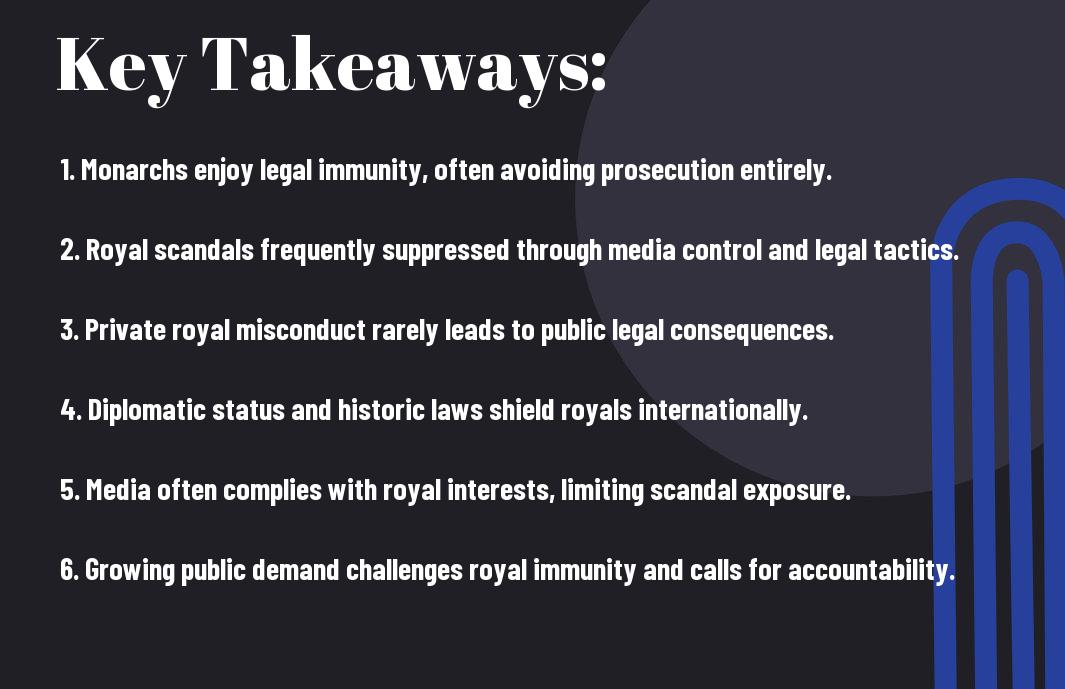
- Members of royal families, particularly in the UK, benefit from legal doctrines like Sovereign Immunity, which often shield them from prosecution in civil and criminal courts.
- Royal privileges extend beyond individual monarchs, creating a system that suppresses scandals through media control, legal loopholes, and political influence.
- Many serious allegations against royals—including abuse of power, financial misconduct, and involvement in criminal activities—go uninvestigated or unprosecuted due to these protections.
- The media frequently collaborates with royal institutions by limiting critical coverage, thereby contributing to public ignorance of royal misconduct.
- Growing public scrutiny and legal debates are challenging the traditional impunity enjoyed by royals, raising questions about the future accountability of monarchy in democratic societies.
Sovereign Immunity: A Legal Shield
The doctrine of Sovereign Immunity acts as a powerful legal barrier that effectively places the reigning monarch beyond the reach of prosecution in both civil and criminal courts. Rooted in centuries-old tradition, this shield protects not only the King or Queen but also casts a protective shadow over the entire royal family. The implications stretch far beyond the UK’s borders, complicating accountability especially when royal actions intersect with foreign jurisdictions and international law.
Historical Origins and Definitions
Emerging from the medieval principle that “the King can do no wrong,” Sovereign Immunity has evolved into a formal legal doctrine preserving the crown’s untouchable status. Historically, it was meant to safeguard the dignity and continuity of the monarchy, but over time it morphed into a broad exemption from prosecution and civil suits. This immunity is grounded in constitutional conventions rather than statutory law, making it a flexible yet elusive concept that resists transparent judicial scrutiny.
The Scope of Legal Exemptions for Monarchs
The reigning monarch is immune from all criminal and civil proceedings within their own country, a protection absolute and unmatched. However, this immunity does not automatically extend to other royals, though various loopholes and privileges often shield them as well. You’ll find diplomatic immunities, private legal settlements, and controlled media coverage converge to maintain this legal fortress, complicating attempts to subject royal family members to ordinary legal processes.
Beyond the monarch, other members of royal families benefit from a patchwork of legal protections that vary by jurisdiction but consistently favor royal privilege. For example, diplomatic immunity can shield a prince or princess accused abroad, and out-of-court settlements often quiet scandals before they reach any trial. Laws designed to protect national security or royal privacy are frequently invoked to block investigations or gag whistleblowers. You might notice that even when evidence surfaces publicly, legal challenges stall indefinitely due to a tangled mix of prerogative powers, parliamentary privileges, and international diplomatic pressure.
Royal Accountability: Analyzing Case Studies in Controversy
Examining specific royal scandals reveals a clear pattern of legal evasion through immunity and influence. Cases like Prince Andrew’s sexual misconduct allegations, Princess Margaret’s extramarital affairs, and Prince Charles’ questionable financial dealings showcase how royals often avoid prosecution despite public evidence and international outrage. These instances emphasize systematic protection, media suppression, and diplomatic shields that prevent justice. Below are key royal scandals with significant legal implications:
- Prince Andrew and Jeffrey Epstein: Detained allegations dating back over a decade, multiple civil lawsuits filed in the U.S., yet no criminal prosecution.
- Princess Margaret’s affairs: Widespread rumors and leaked documents highlighting infidelity without legal scrutiny.
- Prince Charles’ donations: Accusations of improper charitable contributions, raising conflicts of interest and financial transparency concerns.
- Colonial land seizures: Historical fraud affecting indigenous populations, rarely acknowledged or legally challenged.
- Tax evasion exposure: Royal-linked accounts featured in the “Paradise Papers,” but no official investigations followed.
- Alleged racist discrimination: Claims of bias in palace employment practices, yet no formal inquiry or legal action.
- Royal divorce settlements: Highly secretive, avoiding public legal processes.
The Prince Andrew Scandal and Its Legal Implications
Prince Andrew’s ties to convicted sex offender Jeffrey Epstein thrust royal immunity into the global spotlight. Civil lawsuits in the U.S. allege sexual abuse, yet criminal charges remain elusive, largely due to diplomatic immunity and extradition complexities. The scandal exemplifies how legal loopholes and royal privilege obstruct prosecution, even when victims come forward publicly. This case underscores international challenges in holding royalty accountable under foreign legal systems.
Public and Media Reaction: The Impact of Perception on Justice
Public outrage over royal scandals often clashes with media reluctance to report fully, fueled by mutual interests that protect the monarchy’s image. While social media amplifies accusations and demands for accountability, mainstream outlets frequently downplay controversies or impose editorial self-censorship. This skewed coverage shapes public perception, inadvertently shielding royals from scrutiny and creating a narrative where justice feels delayed or denied.
The complex dance between media and monarchy directly influences how scandals unfold. Traditional news organizations often balance exclusives and palace access against criticism, resulting in diluted or late-breaking coverage. Meanwhile, independent and international media, alongside whistleblowers on platforms like Reddit and YouTube, expose details ignored domestically. This uneven spotlight impacts legal proceedings by limiting the pressure necessary for investigations, allowing royals to maintain their status despite mounting proof of wrongdoing. Your understanding of royal accountability must consider this interplay of power, perception, and press control.
Global Perspectives: How Monarchies Navigate Legal Boundaries

Monarchies worldwide apply vastly different legal standards to their royals. In some countries, like the United Kingdom, sovereign immunity literally places the monarch above prosecution, while other nations impose varying degrees of legal accountability on royal family members. These disparities reflect each country’s legal traditions, political structures, and public pressures. You’ll find that some monarchies have evolved legal frameworks to limit immunity, yet many still shield royals through diplomatic privileges or opaque statutes. Understanding these contrasts spotlights how entrenched royal privileges remain, even as democratic ideals push for universal legal equality.
Comparative Analysis of Royal Immunity in Various Countries
| Country | Royal Immunity Status |
|---|---|
| United Kingdom | Reigning monarch has full sovereign immunity; extended protections often protect other royals unofficially. |
| Spain | Constitutional immunity applies mostly to the monarch, but recent court cases have challenged other royals. |
| Sweden | Limited legal immunity; royals can face prosecution but traditionally avoid public scandals. |
| Malaysia | Constitutional immunity for rulers in their states, but reforms introduced limited legal reforms. |
| Japan | The Emperor holds symbolic immunity; other royals are less protected and subject to law. |
Case Examples: Spain’s Infanta Cristina and Legal Reforms in Malaysia
Infanta Cristina’s 2016 trial for alleged involvement in money laundering marked a rare instance where a European royal faced prosecution, signaling a gradual erosion of absolute immunity. In Malaysia, rulers have historically enjoyed broad constitutional immunity, but recent legal reforms aim to limit this privilege, introducing accountability mechanisms previously absent. These cases illustrate the ongoing tug-of-war between royal privilege and legal transparency, revealing cracks in the protective shields once thought impregnable.
The trial of Spain’s Infanta Cristina shattered previous assumptions that European royals could never be held accountable. She was investigated and prosecuted for allegedly facilitating embezzlement through her husband’s company, reflecting growing judicial willingness to pierce royal immunity in corruption cases. Meanwhile, Malaysia’s constitutional monarchs were insulated from lawsuits or investigations, but recent reforms now allow certain legal actions, forcing royals to answer publicly to misconduct claims. These examples highlight the dynamic and evolving legal landscapes monarchies confront, pushing you to reconsider assumptions about royal invincibility in law.
Public Sentiment: The Growing Demand for Transparency
As the veil of royal secrecy thins, public pressure for transparency intensifies worldwide. You’re witnessing increased scrutiny fueled by social media exposure, independent journalism, and brave whistleblowers who pierce the traditional layers of protection. Citizens no longer accept the notion that royals are untouchable; instead, they demand clarity on legal privileges and insist on accountability—especially when scandals cross legal and ethical boundaries. This shift reflects a broader skepticism about inherited power and a call to ensure that no one, regardless of status, evades the law’s reach.
Attitudes Towards Royal Legal Privileges

People are growing increasingly uneasy with the legal immunity granted to royals, especially in democracies where equality before the law is a foundational principle. You encounter rising frustration over doctrines like Sovereign Immunity and diplomatic protections perceived as outmoded loopholes. Polls across the UK and Commonwealth show a significant majority favor shortening or eliminating these legal shields. The perception that royal legal privileges foster inequality and obstruct justice fuels debates on reforming or even abolishing monarchy’s exceptional status.
Advocacy Movements and Their Push for Accountability
Activist groups and legal watchdogs have stepped up efforts to challenge royal immunity, pushing for legislative reform and official inquiries. You’ll find campaigns leveraging high-profile scandals like the Prince Andrew case to spotlight systemic issues. Organizations such as Fair Trials and Transparency International call for enforcing existing laws without exceptions, emphasizing that royals must be subject to the same judicial process as ordinary citizens. Their work includes lobbying governments, raising public awareness, and supporting victims who face obstacles in seeking justice.
Beyond raising awareness, advocacy movements deploy strategic legal challenges and digital campaigns aiming to dismantle royal immunity frameworks. In recent years, petitions backed by tens of thousands have urged parliaments to reconsider laws granting immunity, while lawsuits filed outside traditional courts seek to test the limits of diplomatic protections. These movements capitalize on growing global discontent, connecting royal accountability to broader themes of transparency, human rights, and democratic integrity. Their persistence signals an emerging power shift, where public demand might soon enforce genuine legal consequences on the formerly untouchable.
The Future of Royal Authority: Reassessing Sovereign Immunity
The centuries-old doctrine of Sovereign Immunity, which places reigning monarchs beyond reproach, faces mounting challenges as democratic values demand accountability. Cases like Prince Andrew’s legal battles have exposed cracks in the traditional shield, forcing governments and legal experts to reconsider how immunity applies, especially when royal misconduct spills over national borders. You’re witnessing a growing tension between preserving regal dignity and enforcing the rule of law, with debates intensifying over whether royals should finally answer to courts like any other citizen.
The Case for Legal Reforms in Modern Monarchy
Calls for reform center on ending blanket immunity that shields royals from prosecution, arguing that no individual—regardless of birthright—should be exempt from justice. Proposals include establishing independent oversight bodies and revising statutes to allow investigation of alleged crimes, especially in financial abuse and human rights violations. Legal scholars highlight how states like Belgium and the Netherlands have begun limiting royal privileges, setting precedents that encourage you to question the status quo and demand equal application of the law.
Balancing Tradition with the Rule of Law
Maintaining the symbolic and cultural roles of monarchy while enforcing legal accountability creates a complex balancing act. You will find that some countries, such as Sweden, have modernized their constitutions to reduce royal immunity without dismantling their monarchies entirely. The challenge lies in safeguarding national heritage and public trust while closing loopholes that allow abuse. Navigating this tension demands careful legal frameworks that respect tradition but reinforce justice, so you’re not forced to choose one at the expense of the other.
Examining Sweden’s model, where the monarch’s role is largely ceremonial and legal protections are narrowly tailored, reveals practical pathways for reform. Their approach involves codifying responsibilities clearly and limiting immunity strictly to official acts, not private misconduct. This nuanced framework enables you to uphold royal symbolism and public respect, while ensuring that any criminal behavior—financial fraud or abuse of power—is subject to full legal scrutiny. Such examples illustrate how a monarchy’s survival depends on evolving accountability mechanisms without eroding its foundational traditions.
Summing up
Following this, you can see that the question of whether royals can be prosecuted reveals a complex interplay of legal immunity, media influence, and historic privilege that often shields them from accountability. While you might expect the law to apply equally, royal status frequently creates barriers to justice, especially when misconduct crosses borders or involves public harm. As public scrutiny grows and legal systems face mounting pressure, you are witnessing a slow but significant challenge to the long-standing protections that have allowed royal scandals to remain hidden for too long.
FAQ
Q: Can members of the British Royal Family be prosecuted under UK law?
A: Under the legal doctrine of Sovereign Immunity, the reigning monarch cannot be prosecuted in either civil or criminal court in the UK. While this immunity officially applies only to the monarch, it creates a protective environment that often shields other members of the Royal Family from legal accountability. This results in limited investigations and prosecutions related to royal scandals within the UK legal system.
Q: How do royal privileges affect international legal proceedings involving royals?
A: Royal status may complicate international legal proceedings because diplomatic immunity, treaties, and sovereign relations often provide protection or delay extradition. For example, allegations against royals in countries like the United States can be hindered by diplomatic negotiations, out-of-court settlements, or lack of cooperation from royal institutions, making prosecution difficult.
Q: Why are many royal scandals never fully investigated or prosecuted?
A: Numerous factors contribute to this lack of legal action, including media suppression through exclusive agreements with royal press offices, non-disclosure agreements, intimidation via cease and desist orders, and the strategic use of legal loopholes and parliamentary privileges. Additionally, national respect for monarchy and historic legal protections discourage thorough investigations or prosecutions.
Q: Does media coverage influence public awareness and legal accountability of royal scandals?
A: Yes, media plays a significant role in shaping public perception and legal scrutiny of royal scandals. Many media outlets prioritize access to royal sources over hard-hitting investigative journalism, often resulting in underreported or biased coverage. When certain stories do emerge, royal legal teams may threaten legal actions that suppress wider dissemination, thus limiting public pressure for accountability.
Q: Are there ongoing efforts to change laws or policies to hold royals accountable?
A: Increasing public skepticism and international legal experts have urged inquiries and reforms addressing royal immunity and accountability. Discussions around modernizing or revising legal frameworks exist, particularly in democracies where equality before the law is a foundational principle. However, substantial change remains slow due to the complex interplay of tradition, political will, and diplomatic considerations.

About the author


Understanding Allodial Titles, Land Patents, and Their Legal Implications
In property rights and land ownership, the concepts of allodial titles and land patents hold significant legal weight. These terms are often used in discussions related to the protection of property rights, land ownership, and the interplay between various areas of law such as the Uniform Commercial Code, contract law, constitutional law, and statutory law. In this in-depth blog post, we will explore into the intricacies of allodial titles and land patents, exploring their definitions, legal implications, and dispelling common myths and misconceptions associated with them. Key Takeaways: Allodial Titles Explained: An allodial title represents the highest form of land ownership, granting the owner absolute and unburdened ownership of the property, free from any encumbrances, liens, or taxes imposed by external parties. Land Patents and Their Legal Implications: A land patent is a legal document issued by the government that […]

Outsmart the System: Top Legal Strategies You Need to Know
Understanding the Legal Landscape While the legal system may seem intimidating, grasping its core concepts can empower you to navigate its complexities effectively. Understanding this landscape is vital for anyone looking to outsmart the system and optimize their legal strategies. Whether you’re seeking legal hacks for small businesses or tips on how to use legal loopholes to your advantage, recognizing the different legal frameworks at play can be crucial in making informed decisions. Overview of Legal Systems An understanding of the various legal systems is pivotal for recognizing your rights and obligations. Legal frameworks can vary significantly from one country to another, with common systems including civil law, common law, and religious law. Each system has its own structure, offering unique legal strategies and challenges. For example, in a common law system, previous judicial decisions can influence future cases, allowing […]

Ilataza Ban Yasharahla EL’s Public Records Request for Elyria Board of Education
24-0001492: Ilataza Ban Yasharahla EL's Public Records Request for Elyria Board of Education. All Rights Expressly Reserved and Retained. https://nationalnoticerecord.com/elyria-boe-members-required-to-follow-rulings https://nationalnoticerecord.com/is-elyria-school-board-bound-by-ohio-courts https://nationalnoticerecord.com/understanding-the-oath-of-office-legal-obligations-and-consequences

Ohio Legalizing Recreation Marijuana Use May Hurt Dispensaries in Monroe, Michigan
In recent years, the movement to legalize marijuana for adult recreational use has gained significant momentum across the United States. Ohio, a state long synonymous with conservative values, has also embraced this shift in public opinion. With the passing of Ohio Issue 2 and the Ohio Home Grow Bill, the state has joined the ranks of those allowing the recreational use of marijuana. This blog post will delve into the pros and cons of Ohio's legalization, as well as the potential implications for marijuana dispensaries in Monroe, Michigan, which previously benefited from Ohio buyers crossing state lines. https://www.youtube.com/watch?v=0KRzqZ8dUwc Pros of Ohio's Recreational Marijuana Legalization 1. Economic Boost: Legalizing recreational marijuana in Ohio has the potential to generate substantial economic benefits for the state. The marijuana industry has proven to be a lucrative market, with tax revenue and job creation being […]

The Etymology of “Bey” EXPOSED
TURN UP YOUR VOLUME & PRESS PLAY Have you ever wondered what the true origin and meaning of "Bey" is? We've been told that it means "Governor", "Law Enforcer", Chief, etc. But, what if that's incorrect? What if we've been using the "title", "Bey", incorrectly? FILL OUT THE FORM TO GET STARTED First Name: Last Name: Phone Number: Email: I agree to receive email updates and promotions. Submit

Are You A “Colored Person”?
Tune in as we dissect the term "person of color", exposing how its PURPOSELY steeped in plausibility, DECEPTION, and used as a weapon.

We’ve Been FORCED to Make Some Changes
Due to receiving so many tasks that our work has become more tedious, we've been forced to make some changes at National Notice Record.

Gas Go Express Food Mart Unjust Enrichment Via Debit Card Surcharge Fees
https://www.youtube.com/watch?v=eJknhtE9JEI In this video, I talk about a consumer experience I had while shopping at Gas Go Express Food Mart Gas Station, located at 237 Lake Avenue, Elyria, Ohio. On November 24, 2021, I made a purchase for 4 taxable items at the location. Each item was $0.99 per. With taxes, it came up to $4.26. As I got ready to place my debit card into the card reader, the Gas Go Express Food Mart clerk immediately added a $.50 debit card surcharge fee. As a common practice, some merchants/stores add a surcharge to your total purchase amount when you spend less than $5 or $10 when using a credit/debit card to process the payment. Being a merchant myself, I know that Master Card, Visa, Discover, and some of the other financial institutions have a strict policy that states that […]

States Hide This Secret: ID Laws Every Citizen Must Know
There's a weird comfort in thinking you know your rights until a cop stops you. You walk out the door assuming you're free to roam, but state statutes are actually a legal minefield waiting to trip you up. It's scary. So, do you really need that plastic card just to walk down the street? Sometimes yes. Since the Justice Department Has Demanded Voter Files from at ... least 21 states, we know the government is watching closely. You could be risking fines just by existing in public without papers. Key Takeaways: Ever assume the rules are the same everywhere you go? They definitely aren't. There isn't a single federal law forcing you to hold plastic. Instead, you face a messy patchwork of state-level ID requirements. So what applies in Ohio might get you in trouble in Texas. States hide this […]

DOJ Criticized: Too Tough or Too Soft on Hate Crimes?
Most days you just want to know if your family is actually safer when the DOJ steps into hate crime cases, right? You're stuck hearing that hate crimes are climbing, yet you also hear arguments that federal prosecutors are either swinging too hard or barely swinging at all, so how are you supposed to feel confident in your rights? And when you see bias attacks exploding across race, religion, and identity, you can't help asking yourself: is your Justice Department protecting you... or leaving you hanging? Key Takeaways: Are You Willing To Question How Safe Your Rights Really Are? Hate crime reports keep climbing, yet DOJ prosecutions lag, sparking fear that bias violence is outrunning federal accountability. Civil rights groups say DOJ goes soft, declining clear hate cases and leaving victims asking, "Who actually has our backs?" Civil liberties advocates […]
The Ugly Truth: Political Correctness vs Your Free Speech
Truth is, nearly 60% of Americans already feel they can't say what they really think in public, and you know why. You're watching political correctness creep into your job, your church, your kids' schools, quietly telling you what you're “allowed” to say. That's not respect, that's soft censorship. So ask yourself, if you have to second-guess every word, are you actually free, or just carefully managed? Key Takeaways: Is political correctness quietly turning your God-given right to speak into a permission slip controlled by elites? When you self-censor to avoid punishment, haven't they already taken more of your liberty than any statute could? Every time “offensive” words get punished, doesn't the boundary of what's allowed tighten around your throat? If truth needs protection from open debate, are we protecting people or just protecting the narrative from you? Ask yourself: will […]
The Hidden Loophole Letting Congress Dodge the Constitution
Congress has quietly shifted lawmaking to unelected bodies, and he, she, and they must ask: who governs when faceless agencies write binding rules? This informative overview explains how the delegation loophole lets lawmakers dodge the Constitution while preserving political cover, and it outlines how advocates can push to reclaim legislative power and constitutional accountability. Key Takeaways: Who's really writing the rules that shape your rights? — Congress increasingly delegates lawmaking to agencies, letting unelected officials issue binding regulations that affect daily life. Is delegation sharing power or abandoning it? — The Constitution vests legislative power in Congress; widespread delegation has turned policy-making into agency-driven rulemaking. How did the courts enable this transfer? — The “intelligible principle” doctrine lets statutes authorize broad agency action with minimal guidance, creating a legal escape hatch for lawmakers. Feel the accountability gap? — Delegation lets […]

The Fifth Amendment Loophole Police Don’t Want You to Know
As you consider your rights, you may think that staying silent is a foolproof way to protect yourself, but what if your silence could be used against you? You need to understand that invoking your Fifth Amendment right isn't as simple as just staying quiet, and not knowing the loophole could cost you your freedom. Can you afford to remain uninformed about the potential consequences of your silence, or will you take the necessary steps to protect yourself? Key Takeaways: Are you aware that your silence can be used against you in a court of law, even if you think you're protected by the Fifth Amendment? What if staying silent could actually hurt you, rather than help you? Do you know that the Fifth Amendment loophole allows prosecutors to interpret your silence as evidence of guilt, unless you explicitly invoke […]

Is Gun Registration a Step Toward Confiscation?
It's your right at stake when gun registration moves from recordkeeping to control. Ask yourself: Is registration about safety or seizure? History shows registration often precedes restrictions and sometimes confiscation. You must weigh your privacy against promised safety and expanding governmental access. Stay informed, demand limits, protect your freedom. Key Takeaways: Registration risks creating searchable owner databases — could local records become a national registry? History shows registration often precedes restrictions, bans, and forced buybacks. Who accesses your firearm records — law enforcement, federal agencies, or hackers? If criminals won't register, why should law‑abiding owners surrender privacy and control? State-level registries can be combined de facto into a federal database with data sharing. Registration ties names to serial numbers — is that permission or a path to prohibition? Protect anonymity: fight registrations that enable tracking, seizure, or bureaucratic permission slips. […]
Related
States Hide This Secret: ID Laws Every Citizen Must Know
There's a weird comfort in thinking you know your rights until a cop stops you. You walk out the door assuming you're free to roam, but state statutes are actually a legal minefield waiting to trip you up. It's scary. So, do you really need that plastic card just to walk down the street? Sometimes yes. Since the Justice Department Has Demanded Voter Files from at ... least 21 states, we know the government is watching closely. You could be risking fines just by existing in public without papers. Key Takeaways: Ever assume the rules are the same everywhere you go? They definitely aren't. There isn't a single federal law forcing you to hold plastic. Instead, you face a messy patchwork of state-level ID requirements. So what applies in Ohio might get you in trouble in Texas. States hide this […]
DOJ Criticized: Too Tough or Too Soft on Hate Crimes?
Most days you just want to know if your family is actually safer when the DOJ steps into hate crime cases, right? You're stuck hearing that hate crimes are climbing, yet you also hear arguments that federal prosecutors are either swinging too hard or barely swinging at all, so how are you supposed to feel confident in your rights? And when you see bias attacks exploding across race, religion, and identity, you can't help asking yourself: is your Justice Department protecting you... or leaving you hanging? Key Takeaways: Are You Willing To Question How Safe Your Rights Really Are? Hate crime reports keep climbing, yet DOJ prosecutions lag, sparking fear that bias violence is outrunning federal accountability. Civil rights groups say DOJ goes soft, declining clear hate cases and leaving victims asking, "Who actually has our backs?" Civil liberties advocates […]
The Ugly Truth: Political Correctness vs Your Free Speech
Truth is, nearly 60% of Americans already feel they can't say what they really think in public, and you know why. You're watching political correctness creep into your job, your church, your kids' schools, quietly telling you what you're “allowed” to say. That's not respect, that's soft censorship. So ask yourself, if you have to second-guess every word, are you actually free, or just carefully managed? Key Takeaways: Is political correctness quietly turning your God-given right to speak into a permission slip controlled by elites? When you self-censor to avoid punishment, haven't they already taken more of your liberty than any statute could? Every time “offensive” words get punished, doesn't the boundary of what's allowed tighten around your throat? If truth needs protection from open debate, are we protecting people or just protecting the narrative from you? Ask yourself: will […]
The Hidden Loophole Letting Congress Dodge the Constitution
Congress has quietly shifted lawmaking to unelected bodies, and he, she, and they must ask: who governs when faceless agencies write binding rules? This informative overview explains how the delegation loophole lets lawmakers dodge the Constitution while preserving political cover, and it outlines how advocates can push to reclaim legislative power and constitutional accountability. Key Takeaways: Who's really writing the rules that shape your rights? — Congress increasingly delegates lawmaking to agencies, letting unelected officials issue binding regulations that affect daily life. Is delegation sharing power or abandoning it? — The Constitution vests legislative power in Congress; widespread delegation has turned policy-making into agency-driven rulemaking. How did the courts enable this transfer? — The “intelligible principle” doctrine lets statutes authorize broad agency action with minimal guidance, creating a legal escape hatch for lawmakers. Feel the accountability gap? — Delegation lets […]
The Fifth Amendment Loophole Police Don’t Want You to Know
As you consider your rights, you may think that staying silent is a foolproof way to protect yourself, but what if your silence could be used against you? You need to understand that invoking your Fifth Amendment right isn't as simple as just staying quiet, and not knowing the loophole could cost you your freedom. Can you afford to remain uninformed about the potential consequences of your silence, or will you take the necessary steps to protect yourself? Key Takeaways: Are you aware that your silence can be used against you in a court of law, even if you think you're protected by the Fifth Amendment? What if staying silent could actually hurt you, rather than help you? Do you know that the Fifth Amendment loophole allows prosecutors to interpret your silence as evidence of guilt, unless you explicitly invoke […]
Is Gun Registration a Step Toward Confiscation?
It's your right at stake when gun registration moves from recordkeeping to control. Ask yourself: Is registration about safety or seizure? History shows registration often precedes restrictions and sometimes confiscation. You must weigh your privacy against promised safety and expanding governmental access. Stay informed, demand limits, protect your freedom. Key Takeaways: Registration risks creating searchable owner databases — could local records become a national registry? History shows registration often precedes restrictions, bans, and forced buybacks. Who accesses your firearm records — law enforcement, federal agencies, or hackers? If criminals won't register, why should law‑abiding owners surrender privacy and control? State-level registries can be combined de facto into a federal database with data sharing. Registration ties names to serial numbers — is that permission or a path to prohibition? Protect anonymity: fight registrations that enable tracking, seizure, or bureaucratic permission slips. […]