
It’s a pivotal moment when the legal system grapples with Second Amendment rights for non-violent felons post the USA v. Duarte (2024) ruling. Explore the delicate balance between redemption and public safety in this in-depth analysis. Will responsible gun ownership and a chance at rehabilitation intersect, shaping the future of countless lives and communities?
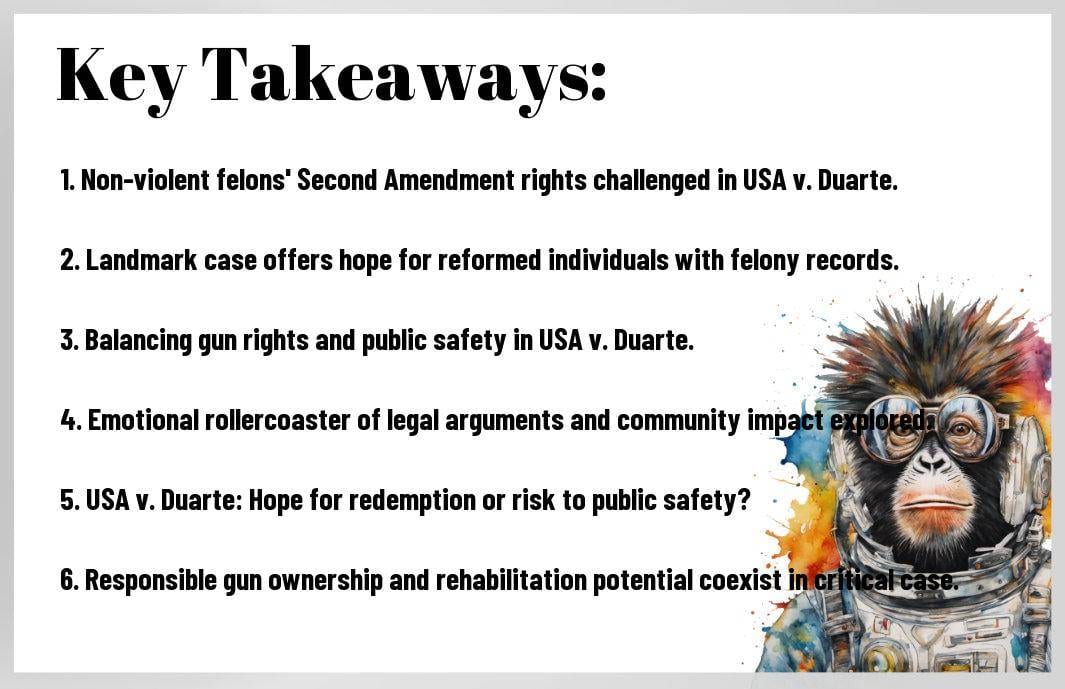
Key Takeaways:
- Landmark Case: USA v. Duarte (2024) provides a glimmer of hope for non-violent felons seeking to regain their Second Amendment rights.
- Legal Precedent: Ninth Circuit Court of Appeals ruled in favor of Duarte by considering historical context, emphasizing Second Amendment rights for non-violent felons.
- Debate Sparked: The case raises questions on balancing redemption opportunities for reformed individuals with concerns over public safety and potential risks of firearm ownership.
- Impact on Communities: The decision in USA v. Duarte could have far-reaching consequences on how past offenders integrate back into society and their ability to protect themselves and their families.
- Complexity Unveiled: The case highlights the intricate balance between rehabilitation, public safety, and constitutional rights, presenting a nuanced discussion on responsible gun ownership.
- Emotional Rollercoaster: Voices from reformed felons, law enforcement, and concerned citizens add depth to the debate, showcasing the personal stakes involved in the Second Amendment discourse.
- Path Forward: Exploring the aftermath of USA v. Duarte, this case challenges us to consider how to navigate the intersection of redemption, safety, and community well-being in firearm ownership.
Hook: The Emotional Weight of Gun Rights
A landmark case like USA v. Duarte (2024) doesn’t just impact legal precedent; it resonates on a deep emotional level with individuals across the nation. The duality of gun rights and felony convictions carries immense weight in our society, touching on themes of redemption, safety, and second chances.
American Values and the Stigma of Felony Convictions
On one hand, there is a fundamental belief in the United States in the power of redemption and second chances. Many argue that individuals who have served their time for non-violent offenses should have the opportunity to reintegrate into society fully, including exercising their Second Amendment rights.
The Human Cost of Restrictive Gun Laws
One cannot ignore the human cost of restrictive gun laws on individuals with felony convictions. The inability to legally possess a firearm for self-defense can leave them vulnerable in dangerous situations, impacting their sense of security and well-being.
Plus, the debate around this issue continues to spark passionate discourse, with valid concerns on both sides regarding public safety and individual rights.
Thesis Statement: A Pivotal Moment for Non-Violent Felons
If the recent ruling in USA v. Duarte (2024) serves as a beacon of hope for non-violent felons seeking redemption and the chance to exercise their Second Amendment rights, it represents a pivotal moment in the ongoing debate surrounding firearm ownership for individuals with felony records.
Introducing the Case of USA v. Duarte
Moment Steven Duarte, a man with a past marred by five non-violent felony convictions, faced federal charges simply for possessing a firearm, the outcome seemed preordained. However, the Ninth Circuit Court of Appeals ruling in his favor, based on the Supreme Court’s decision in New York State Rifle & Pistol Ass’n v. Bruen (2022), has sparked heated discussions regarding the interpretation of gun control laws.
The Broader Implications of the Ruling
With concerns about safety and rehabilitation at the forefront, the ruling in USA v. Duarte raises questions about balancing Second Amendment rights with public safety concerns. The decision provides a glimmer of hope to reformed felons seeking a second chance at responsible gun ownership but also stirs fears of potential risks associated with arming individuals with felony backgrounds.
Case This pivotal legal case challenges the traditional notions of firearm ownership for non-violent felons, offering a glimpse into the complexities surrounding Second Amendment rights, redemption, and community safety.
Steven Duarte’s Story: A Common Tale of Redemption
Once again, we find ourselves drawn to the story of Steven Duarte, a man with a past marked by five non-violent felony convictions. His journey through the legal system, culminating in the landmark case of USA v. Duarte (2024), sheds light on the complexities of Second Amendment rights for individuals with a criminal history.
Background: Duarte’s History and Federal Charges
History: Steven Duarte, like many others, faced federal charges for possessing a firearm despite his non-violent felony convictions. This clash between his desire to exercise his Second Amendment rights and the federal law prohibiting felons from owning firearms encapsulated a broader societal debate.
Legal Precedent: The Impact of New York State Rifle & Pistol Ass’n v. Bruen
Steven: With the Ninth Circuit Court of Appeals ruling in Duarte’s favor, citing the potential infringement on Second Amendment rights for non-violent felons, a new legal precedent was set. This decision not only offers hope for redemption but also sparks concerns about the implications on public safety.
The Legal Landscape: 18 U.S.C. § 922(g)(1)
Statutory Analysis: Breaking Down the Federal Law
Despite the strict guidelines outlined in 18 U.S.C. § 922(g)(1), which generally prohibits firearm ownership for felons, USA v. Duarte (2024) has shed light on potential inconsistencies within the law. By examining the specific language and intent behind this statute, legal experts aim to decipher the nuances that impact individuals like Steven Duarte.
Constitutional Debate: Challenging the Traditional Interpretation
Down the rabbit hole of constitutional interpretation lies the heart of the matter in USA v. Duarte. The Ninth Circuit Court of Appeals’ ruling raises fundamental questions about the intersection of Second Amendment rights and felony convictions. Federal law prohibits non-violent felons from owning firearms, but is this blanket restriction truly in line with the intentions of the founding fathers?
Plus, the Supreme Court’s emphasis on historical context in gun control laws, as seen in New York State Rifle & Pistol Ass’n v. Bruen (2022), underscores the complexity of balancing individual rights with public safety concerns.
Expert Opinions: Insights from Legal Scholars
The Constitutionality of Restricting Gun Rights for Non-Violent Felons
Legal scholars provide valuable insights into the constitutionality of restricting gun rights for non-violent felons. Unlike violent offenders, non-violent felons like Steven Duarte may not pose the same level of danger to society. However, the landscape of Second Amendment rights for individuals with a felony record is complex. Legal experts debate whether blanket restrictions on firearm ownership for non-violent offenders truly align with the principles of justice and rehabilitation.
Balancing Individual Rights with Public Safety Concerns
Concerns arise when balancing individual rights with public safety. Legal scholars research into the potential risks and benefits of allowing non-violent felons to own firearms. While some see it as a chance for redemption, others fear the consequences of arming individuals with a history of criminal behavior. The debate hinges on finding a delicate balance between respecting individual Rights and safeguarding the well-being of communities.
Rights: Striking a balance between individual rights and public safety is crucial for navigating the nuanced terrain of gun ownership for non-violent felons. The insights provided by legal scholars shed light on the complexities of the issue and offer valuable perspectives on the path forward.
The Ripple Effect: Communities in Focus
Personal Narratives: Stories of Reformed Non-Violent Felons
Not every felon is a lost cause, as evidenced by the compelling personal narratives of reformed non-violent felons. Individuals like Steven Duarte have shown that redemption is possible, sparking hope for others with similar pasts. The opportunity for those who have served their time and reformed to reclaim their Second Amendment rights offers a glimpse into the transformative power of forgiveness and rehabilitation.
Public Safety Concerns: The Opposing Viewpoint
With concerns over potential risks, some voices argue against the restoration of firearms rights for non-violent felons. Repeating offenses and safety hazards are at the forefront of their apprehensions, fearing the consequences of placing guns in the hands of individuals with felony records. However, this viewpoint underscores the complexity and sensitivity of the debate surrounding Second Amendment rights for reformed individuals.
Understanding both sides of the argument is crucial in navigating the implications of the USA v. Duarte ruling. While the push for rehabilitation and the recognition of individuals’ ability to change and contribute positively to society are highlighted, the need for cautious consideration of public safety concerns cannot be overlooked.
Voices from the Field: Law Enforcement and Reformed Felons Speak
Law Enforcement Perspective: Opinions from Police Officers and Federal Agents
An overwhelming sense of caution permeates the law enforcement community regarding the recent ruling in USA v. Duarte. While some officers believe in second chances for reformed individuals, others express concerns about potential risks associated with felons owning firearms. The debate within law enforcement mirrors the larger societal divide over the issue.
Reformed Felons: Interviews with Individuals Seeking to Exercise Their Second Amendment Rights
Reformed felons like Sarah, mentioned in the case analysis, finally have a platform to express their desire for redemption and responsibility. These individuals seek to regain their constitutional rights while also proving their commitment to a law-abiding life. Their voices add a powerful personal dimension to the legal debate surrounding gun ownership for convicted felons.
Ref:
The US has seen a landmark ruling in the case of USA v. Duarte, offering hope to non-violent felons looking to exercise their Second Amendment rights. This critical decision has sparked controversy and debate across the nation.
Community Impact: Analyzing the Decision’s Effects
Crime Rates and Community Trust in the Justice System
Many communities are grappling with the implications of the USA v. Duarte ruling. With concerns about potential risks associated with allowing non-violent felons to possess firearms, questions arise about impact on crime rates and community safety. The decision has sparked debates on balancing Second Amendment rights with public safety, raising issues of trust in the justice system.
The Potential for Positive Change
Analyzing the USA v. Duarte ruling also sheds light on the potential for positive change in communities. While some fear repercussions of granting felons access to firearms, others see it as an opportunity for rehabilitation and reintegration. Examining the impact on reformed individuals and empowerment through responsible gun ownership is crucial in understanding the broader implications of this legal precedent.
The Verdict: Analyzing USA v. Duarte
Case Summary: The Court’s Decision and Reasoning
For Steven Duarte and others like him, the Ninth Circuit Court of Appeals’ ruling in USA v. Duarte (2024) was a beacon of hope in the long-standing debate over firearm ownership for non-violent felons. The court’s decision, citing the Supreme Court’s emphasis on historical context in gun control laws, determined that the law Duarte violated likely infringed on Second Amendment rights. This landmark ruling offers a glimmer of hope for reformed individuals seeking redemption and the opportunity to responsibly exercise their right to bear arms.
Historical Context: The Significance of the Second Amendment
Courts have historically grappled with balancing Second Amendment rights and public safety concerns, especially regarding firearm ownership for felons. The Ninth Circuit Court of Appeals’ decision in USA v. Duarte sheds light on the complexities of this issue and underscores the importance of considering historical context when interpreting constitutional rights. As the legal landscape evolves, understanding the delicate balance between individual liberties and public safety remains crucial in shaping future gun control laws.
Legal Implications: The Future of Gun Rights Jurisprudence
For Steven Duarte and countless individuals with a felony record, the ruling in USA v. Duarte (2024) has offered a glimmer of hope in reclaiming their Second Amendment rights. The decision by the Ninth Circuit Court of Appeals to consider the historical context of gun control laws, as highlighted in New York State Rifle & Pistol Ass’n v. Bruen (2022), opens the door for potential future cases challenging restrictions on non-violent felons’ gun ownership rights.
Potential for Future Cases and Evolving Landscapes
One possible trajectory is the gradual expansion of Second Amendment protections for individuals with non-violent felony convictions, emphasizing reformation and rehabilitation over blanket restrictions. This could lead to a shift in the legal landscape, redefining the boundaries of gun rights jurisprudence in the United States.
The Role of the Judiciary in Shaping Gun Laws
Judiciary plays a pivotal role in interpreting and applying gun laws in a manner that balances individual rights with public safety concerns. Their decisions, as seen in USA v. Duarte, can set crucial precedents that shape the future trajectory of gun rights jurisprudence. The judiciary’s careful consideration of constitutional principles and societal implications is crucial in navigating the complex terrain of Second Amendment challenges.
The Path Forward: Redemption and Public Safety
Despite the polarizing nature of the USA v. Duarte case, finding a balance between redemption and public safety is crucial. Policy proposals that consider both perspectives are necessary to navigate this critical issue.
Policy Proposals: Legislative Changes and Initiatives
Any legislative changes must carefully weigh the rights of non-violent felons seeking redemption with the imperative of ensuring public safety. While expanding access to firearm ownership for reformed individuals can be a step towards rehabilitation and second chances, stringent background checks and monitoring mechanisms are necessary to mitigate potential risks.
Rehabilitation Programs: Supporting Reintegration and Responsible Gun Ownership
Safety should always be a top priority when considering the reintegration of non-violent felons into society. Rehabilitation programs that focus on educating individuals on responsible gun ownership practices and providing mental health support can help prevent potential tragedies. It’s crucial to strike a balance between empowering individuals and safeguarding communities.
Plus, fostering a culture of accountability and responsibility among reformed individuals is key to promoting long-term successful reintegration. By offering support and resources tailored to their needs, we can facilitate their journey towards becoming law-abiding citizens who contribute positively to society’s fabric.
Call to Action: Engaging in the Conversation
Advocating for Balanced Solutions
With USA v. Duarte sparking heated debates across the nation, it is crucial for advocates to push for solutions that strike a balance between rehabilitation and public safety.
Spreading Awareness about the Case and Its Implications
Balanced awareness campaigns can help educate the public on the complexities of Second Amendment rights for non-violent felons.
This increase in awareness can foster informed discussions and promote empathy towards those seeking redemption.
Final Words
Upon reflecting on the implications of USA v. Duarte (2024), the debate surrounding Second Amendment rights for non-violent felons remains contentious. The case serves as a pivotal moment, offering a glimmer of hope for those seeking redemption. However, the delicate balance between individual rights and public safety looms large, sparking intense emotions and concerns among stakeholders.
This landmark ruling challenges societal perceptions and legal boundaries, prompting a reevaluation of the intersection between criminal justice reform and gun control. As discussions unfold, it becomes evident that the path forward is multifaceted, requiring a nuanced approach that considers both individual circumstances and community well-being. The story of USA v. Duarte underscores the complexity of the human experience, highlighting the inherent struggles and aspirations that shape our quest for justice and security.
FAQ
Q: Can non-violent felons now own guns after USA v. Duarte (2024) ruling?
A: The ruling in USA v. Duarte (2024) offers a glimmer of hope for non-violent felons to potentially regain their Second Amendment rights, based on historic context.
Q: What was Steven Duarte’s case in USA v. Duarte (2024)?
A: Steven Duarte, with five non-violent felony convictions, faced federal charges for possessing a firearm, leading to a landmark ruling by the Ninth Circuit Court of Appeals.
Q: How did the court ruling impact non-violent felons like Duarte?
A: The court found that the law Duarte violated likely infringed on the Second Amendment rights of non-violent felons, offering a potential chance for redemption.
Q: What are the arguments for allowing non-violent felons to own guns?
A: Advocates believe reformed individuals deserve a second chance at responsible gun ownership for self-protection and family safety.
Q: What are the concerns about allowing non-violent felons to own guns?
A: Critics fear the risks of granting firearm access to individuals with felony records, citing potential for repeat offenses and safety hazards.
Q: What impact does USA v. Duarte (2024) have on communities?
A: The case sparks a debate on balancing gun rights and public safety, with implications for rehabilitation, community safety, and legal precedents.
Q: How does USA v. Duarte (2024) challenge perceptions of gun ownership?
A: The case prompts reflection on the complex relationship between responsible gun ownership, redemption, and societal safety, highlighting the need for nuanced perspectives.
Q: What is the significance of exploring USA v. Duarte (2024) in depth?
A: Delving into the legal, emotional, and societal aspects of the case allows for a comprehensive examination of the potential outcomes and implications for individuals and communities.


About the author


Understanding Allodial Titles, Land Patents, and Their Legal Implications
In property rights and land ownership, the concepts of allodial titles and land patents hold significant legal weight. These terms are often used in discussions related to the protection of property rights, land ownership, and the interplay between various areas of law such as the Uniform Commercial Code, contract law, constitutional law, and statutory law. In this in-depth blog post, we will explore into the intricacies of allodial titles and land patents, exploring their definitions, legal implications, and dispelling common myths and misconceptions associated with them. Key Takeaways: Allodial Titles Explained: An allodial title represents the highest form of land ownership, granting the owner absolute and unburdened ownership of the property, free from any encumbrances, liens, or taxes imposed by external parties. Land Patents and Their Legal Implications: A land patent is a legal document issued by the government that […]

Outsmart the System: Top Legal Strategies You Need to Know
Understanding the Legal Landscape While the legal system may seem intimidating, grasping its core concepts can empower you to navigate its complexities effectively. Understanding this landscape is vital for anyone looking to outsmart the system and optimize their legal strategies. Whether you’re seeking legal hacks for small businesses or tips on how to use legal loopholes to your advantage, recognizing the different legal frameworks at play can be crucial in making informed decisions. Overview of Legal Systems An understanding of the various legal systems is pivotal for recognizing your rights and obligations. Legal frameworks can vary significantly from one country to another, with common systems including civil law, common law, and religious law. Each system has its own structure, offering unique legal strategies and challenges. For example, in a common law system, previous judicial decisions can influence future cases, allowing […]

Ilataza Ban Yasharahla EL’s Public Records Request for Elyria Board of Education
24-0001492: Ilataza Ban Yasharahla EL's Public Records Request for Elyria Board of Education. All Rights Expressly Reserved and Retained. https://nationalnoticerecord.com/elyria-boe-members-required-to-follow-rulings https://nationalnoticerecord.com/is-elyria-school-board-bound-by-ohio-courts https://nationalnoticerecord.com/understanding-the-oath-of-office-legal-obligations-and-consequences

Ohio Legalizing Recreation Marijuana Use May Hurt Dispensaries in Monroe, Michigan
In recent years, the movement to legalize marijuana for adult recreational use has gained significant momentum across the United States. Ohio, a state long synonymous with conservative values, has also embraced this shift in public opinion. With the passing of Ohio Issue 2 and the Ohio Home Grow Bill, the state has joined the ranks of those allowing the recreational use of marijuana. This blog post will delve into the pros and cons of Ohio's legalization, as well as the potential implications for marijuana dispensaries in Monroe, Michigan, which previously benefited from Ohio buyers crossing state lines. https://www.youtube.com/watch?v=0KRzqZ8dUwc Pros of Ohio's Recreational Marijuana Legalization 1. Economic Boost: Legalizing recreational marijuana in Ohio has the potential to generate substantial economic benefits for the state. The marijuana industry has proven to be a lucrative market, with tax revenue and job creation being […]

The Etymology of “Bey” EXPOSED
TURN UP YOUR VOLUME & PRESS PLAY Have you ever wondered what the true origin and meaning of "Bey" is? We've been told that it means "Governor", "Law Enforcer", Chief, etc. But, what if that's incorrect? What if we've been using the "title", "Bey", incorrectly? FILL OUT THE FORM TO GET STARTED First Name: Last Name: Phone Number: Email: I agree to receive email updates and promotions. Submit

Are You A “Colored Person”?
Tune in as we dissect the term "person of color", exposing how its PURPOSELY steeped in plausibility, DECEPTION, and used as a weapon.

We’ve Been FORCED to Make Some Changes
Due to receiving so many tasks that our work has become more tedious, we've been forced to make some changes at National Notice Record.

Gas Go Express Food Mart Unjust Enrichment Via Debit Card Surcharge Fees
https://www.youtube.com/watch?v=eJknhtE9JEI In this video, I talk about a consumer experience I had while shopping at Gas Go Express Food Mart Gas Station, located at 237 Lake Avenue, Elyria, Ohio. On November 24, 2021, I made a purchase for 4 taxable items at the location. Each item was $0.99 per. With taxes, it came up to $4.26. As I got ready to place my debit card into the card reader, the Gas Go Express Food Mart clerk immediately added a $.50 debit card surcharge fee. As a common practice, some merchants/stores add a surcharge to your total purchase amount when you spend less than $5 or $10 when using a credit/debit card to process the payment. Being a merchant myself, I know that Master Card, Visa, Discover, and some of the other financial institutions have a strict policy that states that […]

Is Your Signature a Trap? The UCC Truth
Just a quick question for you: Are you sure about what your signature really means? Your signature, under the Uniform Commercial Code (UCC), isn't just an autograph. It can be a legal trap, binding you to terms you never fully understood. Learn to protect yourself from these hidden dangers in commercial transactions. Seriously, is your signature actually a legal trap or just a silent endorsement? You probably think your signature is just a formality, right? But under the Uniform Commercial Code (UCC), it's much more. Your signature acts as a binding endorsement, fueling the financial system, often at your personal expense. Why we're conditioned to sign stuff without looking and the bad news that follows Ever feel rushed to sign? This conditioning makes you enter "contracts of adhesion." You're then seen as a "debtor" or "representative", not a living person […]

The Merchant’s Bible: Decoding UCC Article 1
Many entrepreneurs overlook the bedrock of commercial law. You must understand UCC Article 1. This article governs your business transactions, from agreements to definitions. Ignoring these foundational provisions can lead to costly disputes. Master this crucial legal framework to protect your interests and achieve success. Key Takeaways: * UCC Article 1 forms the foundational rules of US commercial law. It defines core concepts, distinguishing an "agreement" from a binding "contract."* Merchants must recognize that UCC Article 1 rules often supersede common law in business dealings. This shift dictates different legal obligations and expectations.* Certain mandates cannot be disclaimed, including good faith, diligence, reasonableness, and care. These duties always govern commercial transactions.* Past actions, such as course of dealing and course of performance, can redefine written contracts. Documenting reservations of rights protects legal leverage.* UCC Article 1 is adapting to the […]

Hidden in Plain Sight: The UCC 1-308 Shield
You probably feel something is off. You sign documents daily, but do you truly understand their hidden implications? This little-known shield can protect your inherent rights. It's a secret many miss, but you don't have to be one of them. Key Takeaways: You know, there's this growing buzz online about reclaiming personal sovereignty, and a lot of folks are looking into how the Uniform Commercial Code fits into that. It feels like we're all just waking up to how much of our lives are governed by unspoken rules. * Signing documents "without prejudice UCC 1-308" isn't just legal jargon; it's a profound declaration. This simple act communicates you are performing an action, but you aren't consenting to hidden contract terms. * Many everyday agreements, like your driver's license application, are "adhesion contracts." You typically accept their terms completely, or you […]

UCC Secrets: The Code That Owns Your Daily Life
UCC is everywhere, shaping your financial reality. You might not realize it, but the Uniform Commercial Code governs your daily life. This code dictates how your assets are handled, often without your explicit understanding. You need to know these secrets. Key Takeaways: You know, most folks think they're playing by "Civil Law" rules, but the truth is, the Uniform Commercial Code (UCC) is the real silent puppet master pulling the strings of daily life. It's not just some obscure legal jargon; it's the very foundation of our commercial world. That "Corporate Personhood" stuff in the UCC isn't just for big companies; it's about the "Strawman" created with your birth certificate. This legal fiction might be the key to understanding why your identity feels like a perfected security interest. UCC 1-308, that "without prejudice" phrase, it's not a magic spell, but […]

What If Traffic Tickets Are Just Municipal Profit Schemes?
The Great Harvesting: Why Traffic Tickets are Municipal Profit Schemes I. What If Traffic Tickets Were Never About Safety? What if everything you’ve been told about traffic tickets is wrong? What if traffic enforcement has quietly shifted from “public safety” to public revenue? This shift transforms ordinary citizens into municipal ATMs. You are not being “protected” on the road. Instead, you are being harvested. This is happening algorithmically, administratively, and unconstitutionally. For decades, Americans accepted traffic tickets as routine. But here is the question almost no one asks. Are traffic tickets unconstitutional? Is this a cleverly disguised municipal profit scheme? These municipal corporations depend on fines. They need them like businesses depend on sales. There is a massive rise in public distrust today. People ask: “Are traffic tickets unconstitutional revenue streams?” This is an explosive search trend across all major […]

Service Providers Are Hiding Fees-and It’s NOT Legal
Many of you have likely felt the sting of unexpected charges on your bills. You signed a contract, yet the total is higher than expected. This isn't just annoying; it's often illegal. You deserve to know every cost upfront. Are you tired of feeling cheated by hidden fees? Key Takeaways: * Does that bill make your stomach drop? Hidden fees are a sneaky strategy, not an accident, making your monthly charges mysteriously higher than expected.* Are they playing fair with your money? Companies often use vague terms like “service fees” or “administrative costs” to mask charges you never agreed to.* Is this even legal? No, concealing fees violates consumer protection laws, making it deceptive and unfair to you.* Why did they hide it from you? Businesses exploit emotions, getting you to commit before revealing the costly details in fine print.* […]
Related
Is Your Signature a Trap? The UCC Truth
Just a quick question for you: Are you sure about what your signature really means? Your signature, under the Uniform Commercial Code (UCC), isn't just an autograph. It can be a legal trap, binding you to terms you never fully understood. Learn to protect yourself from these hidden dangers in commercial transactions. Seriously, is your signature actually a legal trap or just a silent endorsement? You probably think your signature is just a formality, right? But under the Uniform Commercial Code (UCC), it's much more. Your signature acts as a binding endorsement, fueling the financial system, often at your personal expense. Why we're conditioned to sign stuff without looking and the bad news that follows Ever feel rushed to sign? This conditioning makes you enter "contracts of adhesion." You're then seen as a "debtor" or "representative", not a living person […]
The Merchant’s Bible: Decoding UCC Article 1
Many entrepreneurs overlook the bedrock of commercial law. You must understand UCC Article 1. This article governs your business transactions, from agreements to definitions. Ignoring these foundational provisions can lead to costly disputes. Master this crucial legal framework to protect your interests and achieve success. Key Takeaways: * UCC Article 1 forms the foundational rules of US commercial law. It defines core concepts, distinguishing an "agreement" from a binding "contract."* Merchants must recognize that UCC Article 1 rules often supersede common law in business dealings. This shift dictates different legal obligations and expectations.* Certain mandates cannot be disclaimed, including good faith, diligence, reasonableness, and care. These duties always govern commercial transactions.* Past actions, such as course of dealing and course of performance, can redefine written contracts. Documenting reservations of rights protects legal leverage.* UCC Article 1 is adapting to the […]
Hidden in Plain Sight: The UCC 1-308 Shield
You probably feel something is off. You sign documents daily, but do you truly understand their hidden implications? This little-known shield can protect your inherent rights. It's a secret many miss, but you don't have to be one of them. Key Takeaways: You know, there's this growing buzz online about reclaiming personal sovereignty, and a lot of folks are looking into how the Uniform Commercial Code fits into that. It feels like we're all just waking up to how much of our lives are governed by unspoken rules. * Signing documents "without prejudice UCC 1-308" isn't just legal jargon; it's a profound declaration. This simple act communicates you are performing an action, but you aren't consenting to hidden contract terms. * Many everyday agreements, like your driver's license application, are "adhesion contracts." You typically accept their terms completely, or you […]
UCC Secrets: The Code That Owns Your Daily Life
UCC is everywhere, shaping your financial reality. You might not realize it, but the Uniform Commercial Code governs your daily life. This code dictates how your assets are handled, often without your explicit understanding. You need to know these secrets. Key Takeaways: You know, most folks think they're playing by "Civil Law" rules, but the truth is, the Uniform Commercial Code (UCC) is the real silent puppet master pulling the strings of daily life. It's not just some obscure legal jargon; it's the very foundation of our commercial world. That "Corporate Personhood" stuff in the UCC isn't just for big companies; it's about the "Strawman" created with your birth certificate. This legal fiction might be the key to understanding why your identity feels like a perfected security interest. UCC 1-308, that "without prejudice" phrase, it's not a magic spell, but […]
What If Traffic Tickets Are Just Municipal Profit Schemes?
The Great Harvesting: Why Traffic Tickets are Municipal Profit Schemes I. What If Traffic Tickets Were Never About Safety? What if everything you’ve been told about traffic tickets is wrong? What if traffic enforcement has quietly shifted from “public safety” to public revenue? This shift transforms ordinary citizens into municipal ATMs. You are not being “protected” on the road. Instead, you are being harvested. This is happening algorithmically, administratively, and unconstitutionally. For decades, Americans accepted traffic tickets as routine. But here is the question almost no one asks. Are traffic tickets unconstitutional? Is this a cleverly disguised municipal profit scheme? These municipal corporations depend on fines. They need them like businesses depend on sales. There is a massive rise in public distrust today. People ask: “Are traffic tickets unconstitutional revenue streams?” This is an explosive search trend across all major […]
Service Providers Are Hiding Fees-and It’s NOT Legal
Many of you have likely felt the sting of unexpected charges on your bills. You signed a contract, yet the total is higher than expected. This isn't just annoying; it's often illegal. You deserve to know every cost upfront. Are you tired of feeling cheated by hidden fees? Key Takeaways: * Does that bill make your stomach drop? Hidden fees are a sneaky strategy, not an accident, making your monthly charges mysteriously higher than expected.* Are they playing fair with your money? Companies often use vague terms like “service fees” or “administrative costs” to mask charges you never agreed to.* Is this even legal? No, concealing fees violates consumer protection laws, making it deceptive and unfair to you.* Why did they hide it from you? Businesses exploit emotions, getting you to commit before revealing the costly details in fine print.* […]